Websites · Published on November 22, 2026
A website for your shop: what you need and how to get it right
ViceSite · Vicedomini Softworks srl
Brochure website, catalogue or e-commerce: how to choose a website for your shop or workshop, which pages and legal requirements to cover, and how to get online without the stress.
A website for a shop has one clear job: to bring people who search for you online into your shop, onto the phone or to the checkout. Most customers look things up online even when they end up buying in person. That is why the right website is not the one with the most features. It is the one built around how you actually sell, with a domain, hosting and email that work together, and someone to ask when something goes wrong. That is the service we offer at ViceSite: a domain, hosting and a custom website, with clear VAT-inclusive prices and support in Italian. This guide explains how to choose your website type, which pages you need, what the law requires and how to get online step by step, whether you run a shop, an artisan workshop or a professional practice.
At a glance
- More than 8 in 10 Italians look for information online before buying in a shop: without a website, that search leads elsewhere.
- Before choosing a platform, choose your model: a brochure website, catalogue or online shop, depending on how you complete a sale.
- Every business website must legally display certain details: business identity, contact details, VAT number, registration details, and privacy and cookie information.
- The real cost includes the domain, hosting, website, email and renewals: ask for VAT-inclusive prices and no domain lock-in.
- A custom website managed by a single Italian-speaking contact takes the technical work off your hands, leaving you free to run your shop.
Contents
- Why a physical shop needs a website
- Brochure website, catalogue or online shop: which should you choose?
- The essential pages
- What your website must display by law
- How to create your shop's website, step by step
- What a shop website really costs
- Your shop online, without the technical worries
- Our perspective
- After launch: getting found
- Frequently asked questions
- Sources
Why a physical shop needs a website
Your local shop is not competing with the web: it depends on it. A ShopFully survey from February 2024 found that 95% of the Italian consumers surveyed prefer to buy in physical shops, but 83% use digital channels to research products before visiting. In practice, customers decide online where to go, then buy in person.
Someone searching for “hardware shop open Saturday” or “clothing alterations near me” wants three answers within seconds: what you sell, where you are and when you are open. If your website provides them clearly, the customer comes to you. If it does not exist, or still shows opening hours from three years ago, they go to whoever answers those questions better.
More established businesses have understood this for a long time: according to the Istat report on businesses and ICT 2025, 76.5% of Italian businesses with at least 10 employees have a website. For a shop or craft business with a small team, a well-maintained website is a practical way to present the same professional image.
The business website guide from Cliclavoro, the Ministry of Labour's portal, identifies the right starting point: clarify the website's goal (providing information, selling, collecting enquiries or strengthening your brand) and build pages that guide visitors towards a specific action, such as filling in a form or requesting a quote. For a shop, that action might be a phone call, a booking, an availability enquiry or a purchase.

Brochure website, catalogue or online shop: which should you choose?
The right question is not “what kind of website do I want?” but “how do I close a sale?” The answer points to the right model.
| Model | When it makes sense | Typical examples | What else you need |
|---|---|---|---|
| Brochure website | The sale is completed in the shop, over the phone or at an appointment | Hairdresser, optician, carpenter, tailor | Opening hours, map, contact details, portfolio gallery |
| Online catalogue | Customers want to view and compare products before asking about availability | Furniture, spare parts, handmade ceramics | Product pages, filters, enquiry form |
| Online shop | You have stable prices, up-to-date stock levels and can manage shipping and returns | Accessories, cosmetics, packaged food products | Shopping cart, payments, terms of sale, order management |
The three models can work together. Many shops start with a brochure website and a catalogue section, then add online sales for some products: those with fixed prices and straightforward shipping. A craftsperson doing bespoke work, on the other hand, mainly needs a gallery of well-photographed projects and a form that collects the information needed for a quote: measurements, materials and timescales.
A practical question: who will update prices and availability every day? If the answer is “no one has time”, an e-commerce site with thousands of items becomes a problem. A carefully maintained catalogue is better than a shopping cart full of out-of-stock products.
If you want to sell online
An online shop demands a little more from your infrastructure: fast product pages, payments protected by a security certificate, regular backups and enough storage for images and orders. If you want an idea of the technical features that matter for a digital shop, an overview comparing e-commerce hosting helps you understand what to look for, from secure checkout to service reliability. On our blog, we explain what secure hosting for businesses needs to provide: it is the foundation of any website that accepts payments.
The essential pages
A shop website does not need dozens of pages. It needs the right ones, well written.
- Home: one sentence explaining who you are, what you sell and where. Below it, the button that matters: call, visit us or explore our products.
- Products or services: your main categories with real photos, not stock images. For craftspeople, completed projects with a short description.
- About us: the shop's story and the people behind the counter. This is what sets an independent shop apart from a chain.
- Location and opening hours: address, map, parking, current opening hours and holiday closures.
- Contact: a clickable phone number, an email address using your domain, and optionally WhatsApp and a simple form.
- Legal pages: legal notice, privacy and cookie policies, and terms of sale if you sell online.
Two details make a difference. First, the website must work well on a smartphone, because people often search for shops while out and about. We cover this in our guide to responsive websites. Second, email. An address such as info@nomenegozio.it inspires more trust than a generic mailbox and reinforces your brand with every message. For ideas on creating a consistent image across your signage, website and social media, see our guide to online branding for small businesses.
What your website must display by law
A business website is not just a showcase: it is also a place where specific rules apply. The Your Europe page on SME websites, on the European Union's official portal, lists the information that must be visible:
- business name, physical address and email address;
- telephone number, if different from the main contact details;
- legal structure and business register details;
- VAT number, where applicable;
- supervisory authority, if the business requires authorisation;
- privacy and cookie information.
If you sell online, you also need terms of sale that customers can read before purchasing, with clear prices and delivery charges shown separately, plus a link to the European dispute resolution platform where required. The same page highlights the rules against geo-blocking: you cannot restrict access to your online shop based on a customer's nationality or location, or automatically change prices based on where they connect from, unless legally required.
For cookies, a consent banner is needed when the website uses third-party analytics or profiling tools. For legal texts, policies and terms of sale tailored to your business, your accountant or a privacy consultant remains the person to consult: these documents have legal consequences and must be adapted to your circumstances.
How to create your shop's website, step by step
Here is the full process, including the most common mistakes at each stage.
1. Define your goal and model
Choose between a brochure website, catalogue and online shop using the table above. Write down in one line what the website should do: “get people to call for an appointment”, “bring people into the shop on Saturdays” or “sell packaged products throughout Italy”. The typical mistake is wanting everything straight away and ending up with a website full of empty sections.
2. Choose and register your domain
Your domain is your address on the web: ideally short, easy to say over the phone, and including your shop's name and your city if the name is common. A .it domain immediately signals that you are an Italian business. The most expensive mistake is registering it in someone else's name, such as your trusted IT technician, and discovering years later that you cannot move it. With ViceSite, you register your domain without lock-in: it stays yours.
3. Activate hosting and email
Hosting is the space where your website “lives”, keeping it online, fast and protected. It makes sense to set up email accounts on your domain at the same time. Where things go wrong: choosing solely on the first-year price and ignoring security, backups and support. To learn more, read how to choose hosting for business websites. With us, your domain, hosting and email are managed in the same place, with a single point of contact.
4. Prepare your content
This is the part only you can really do well: photos of your shop and products, your story, opening hours and the questions customers ask most often at the counter. Clear photos taken in natural light and simple text written as you would speak to a customer are enough. The most common mistake is putting this step off and holding up the entire project.
5. Build the website
With a DIY website builder, you spend evenings working through templates, settings and plugins, and the result often looks like a thousand other websites. With a custom website, you start with your content and your goal, while a professional handles the technical side. That is what we do with our Custom Website service, without the technical jargon. We explain what a complete project should include in our guide to turnkey websites.
6. Check before publishing
Before launch, check on both a smartphone and a computer: a clickable phone number, the correct map, up-to-date opening hours, forms that actually reach your inbox, legal pages in place and mandatory details at the bottom of every page. A form that sends nothing is the most common fault, and the easiest to miss.
7. Link to your website everywhere
Add the address to your Google Business Profile, social media profiles, business cards, shopping bags and shop window. Your website works when people can find it.
What a shop website really costs
A website's price is not a single figure. These are the costs to consider:
- Domain: an annual fee, with attention to the renewal price, not just the first year.
- Hosting: a recurring fee that increases if the website includes an online shop with lots of products and orders.
- Email accounts: sometimes included, sometimes charged separately.
- Website development: a one-off cost based on the number of pages and features, such as a catalogue or shopping cart.
- Maintenance and changes: updates, security and small changes to text and photos.
Surprises almost always come from the same places: prices shown without VAT, renewals that cost more than the first year, domain transfer fees and paid support. Before deciding, ask for a clear VAT-inclusive price for each item and check that the domain stays yours. These are the principles we built ViceSite on: transparent VAT-inclusive prices and no hidden costs. For e-commerce, add payment processing fees and shipping costs, which depend on the providers you choose.
Your shop online, without the technical worries
With ViceSite, everything your shop's website needs is in one place: domain registration, secure hosting, email accounts and a custom website built around how you sell. The process has three steps: choose your service, pay securely and the service activates immediately.
Clear VAT-inclusive prices, no domain lock-in and an Italian team that genuinely responds, without call centres or tickets. Explore domains, hosting and custom websites or, if you already have a website to move, request hosting.
Our perspective
Shop owners already have a full-time job: orders, suppliers, customers at the counter and month-end accounts. They should not have to become their own IT technician just to have a website that works.
That is why we believe a small shop or craft business needs simplicity and someone to talk to above all else. Having your domain, hosting, email and website in one place means one person to call, one invoice to read and no being passed between providers when an email account stops receiving messages on a Saturday morning.
We also believe in custom websites. A bakery's website should not look like a garage's, and neither should look like a template you have seen a thousand times. Starting with how you sell, who your customers are and what they ask over the phone creates a more useful website than any extra feature.
And we believe in transparency: VAT-inclusive prices, no hidden costs and a domain that stays yours. These are simple terms, but they are what allow business owners to trust their provider and focus on their work.
Sofia
After launch: getting found
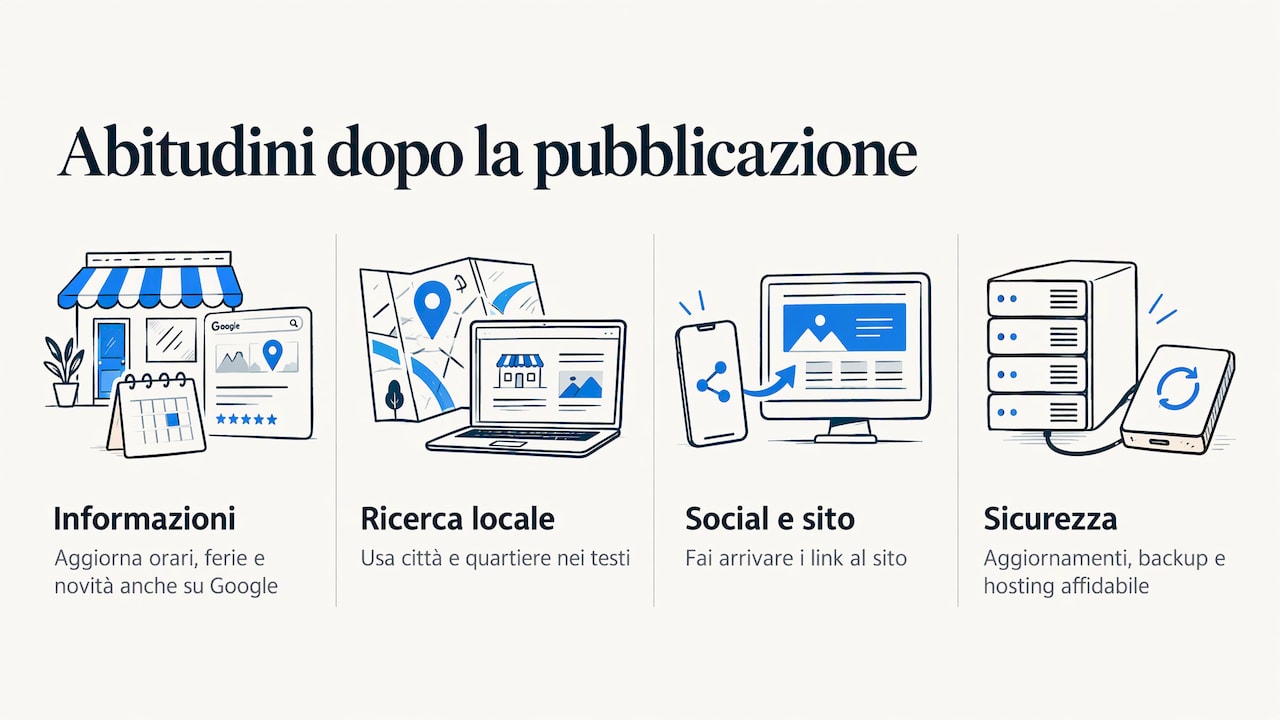
A published website is a starting point. Three habits keep it useful over time.
Keep practical information up to date. Opening hours, holiday closures, new arrivals and in-store events. Incorrect information is more likely to lose you a customer than a less polished design. Every change should also be reflected in your Google Business Profile so the two sources do not contradict each other.
Write for people searching nearby. In headings and text, use your customers' own words, along with your neighbourhood or city: “bicycle repairs in Bologna”, “custom picture frames in Verona”. A page for each main service helps search engines understand what you offer and where.
Use social media as your shop window and your website as your home. Photos and stories on social media attract attention, but platform rules change and content gets lost in the feed. Your website stays yours: that is where your links should lead, and where customers should find everything neatly organised.
Finally, security: updates, backups and reliable hosting prevent most problems. If you suspect you have already been attacked, our guide to dealing with a hacked website explains how to spot it and what to do.
Frequently asked questions
Does a craftsperson need a website, or is social media enough?
Social media is useful for showcasing your work, but it does not replace a website. Your website belongs to you, appears in Google searches for your name and city, and brings your work, contact details and quote requests together in one place. For a craftsperson, a brochure website with a gallery and contact form is often the most effective choice.
Is a brochure website or an e-commerce site better for my shop?
It depends on how you close the sale. If customers visit your shop or call you, start with a brochure website and catalogue. If you have products with stable prices and can manage orders, shipping and returns, add online sales, even if only for part of your range.
How long does it take to get a shop website online?
Domains and hosting can be activated quickly: with ViceSite, activation is immediate after payment. The time needed for the website itself depends mainly on the content: having photos, text and opening hours ready makes a big difference.
Can I change providers without losing my domain?
Yes, if the domain is registered in your name and the provider does not impose restrictions. That is why it is worth checking before you choose. With ViceSite, there is no domain lock-in: it stays yours.
What details should I put in my website's footer?
Your business name, address, email, VAT number, legal structure and business register details, along with links to privacy and cookie policies. If you sell online, you also need terms of sale. For legal texts, consult your accountant or a privacy consultant.
Sources
- Engage: Italians buy in physical shops but plan their purchases online
- Istat: businesses and ICT, 2025
- Cliclavoro: how to create a business website today
- Your Europe: creating a website for SMEs
- Compare UK Hosting: e-commerce hosting
Recommended
Ready to take your business online?
Search your domain: in two minutes you'll know if it's free and what it costs, VAT included.
Find your domain