Websites · Published on November 11, 2026
Turnkey website: what’s included and how to choose one
ViceSite · Vicedomini Softworks srl
What a turnkey website really includes, how the process works, what to prepare and what to check in the quote to get a domain, hosting and website without surprises.

A turnkey website is a website delivered ready to use: a single provider registers the domain, activates the hosting, sets up email accounts, builds the website and hands it over in working order. You provide the content and make the decisions; they handle the rest. For a small business, an independent professional or a startup, the real benefit is not the convenience of a single invoice. What matters is having one person accountable when something goes wrong, clear prices from the outset and a domain that remains yours. This is how we work at ViceSite: a domain, hosting and a custom website, with support in Italian from real people and VAT-inclusive prices.
At a glance
- Turnkey means your domain, hosting, email and website come from a single provider and are delivered in working order, along with your login credentials.
- Your job is to provide copy, a logo, photos and business details. Almost all delays come from this stage, not the technical side.
- The price should be broken down into two parts: the one-off build cost and recurring costs (domain, hosting, email, maintenance). Always ask for VAT-inclusive figures.
- In the contract, check that the domain is registered in your company’s name, that you receive login access and that there are no restrictions on moving it elsewhere.
- Privacy and cookies remain your responsibility as the website owner, even when the provider handles the technical side.
Contents
- What “turnkey” really means
- The components of a complete package
- How the build works, step by step
- Materials to prepare before you start
- Why use a single provider for everything
- How much a turnkey website costs: items to consider
- Quote and contract: what to check before signing
- Privacy and cookies: what remains your responsibility
- A turnkey website with ViceSite
- Our perspective
- Frequently asked questions
- Sources
What “turnkey” really means
The expression comes from construction: you buy a finished house, walk in and turn the key. Applied to the web, it describes a service where you don’t have to coordinate three or four different providers—one for the domain, one for hosting, a designer and a developer—and you don’t have to learn terms such as DNS, SSL certificate or CMS.
In practice, a turnkey website covers everything needed to get the website online and usable:
- the domain, meaning the website’s address (for example, nomeazienda.it);
- the hosting, the space on a server where the website “lives” and is accessible around the clock;
- email accounts using your domain (info@nomeazienda.it instead of a free email address);
- the website itself: page structure, design, content entry, contact forms and a smartphone-friendly version;
- the launch and handover of login details.
The difference compared with a DIY website builder is substantial. With DIY, the time, technical decisions and mistakes are yours. With a turnkey service, you pay someone who does this every day to make those decisions for you and take responsibility for the result. For someone running a business, the time saved is almost always worth more than the price difference.
The components of a complete package
Not every service described as “turnkey” includes the same things. This table helps you understand what should be included and what to ask about each item.
| Component | What it does | What to ask the provider |
|---|---|---|
| Domain | It is your website’s name and the basis of your email address | Is it registered in my company’s name? Can I transfer it whenever I want? |
| Hosting | Keeps the website online, fast and secure | Are an SSL certificate (HTTPS) and backups included? |
| Professional email | Lets you communicate with customers and suppliers using your brand | How many mailboxes and how much storage are included? |
| Custom website | Presents your business and generates enquiries | How many pages and revisions are included? Is it smartphone-friendly? |
| Launch | Connects the domain, hosting and website | Who sets up DNS and email? Will I receive all login credentials? |
| Support | Resolves issues and makes changes after handover | Who responds, in what language and through which channel? |
If you would like to explore individual items in more detail, we have dedicated guides to what secure hosting should provide and how to get a professional email address with your domain.
How the build works, step by step
A well-managed project always follows the same sequence. Here are the steps, including the points where time is usually lost.
- Choosing the service. Decide what you need: just a domain and hosting, or a custom website and email accounts too. A common mistake is buying the pieces from different providers “to save money”, only to discover that no one will connect them. With us, choosing is the first of three steps: service selection, secure payment and activation.
- Choosing and registering the domain. The name should be short, easy to spell out over the phone and consistent with your brand. Check that the domain is registered in your company’s name, not the provider’s. With ViceSite, there is no domain lock-in: it remains yours.
- Payment and activation. After secure payment, the domain and hosting are activated immediately. Transparency matters here: a VAT-inclusive price, with no last-minute extras.
- Gathering content. This is the stage where projects most often stall. The provider cannot explain what you do and who you do it for without your input. The better prepared you are, the sooner the website will be ready (you’ll find the full checklist in the next section).
- Design and development. The pages, design and copy are defined. A custom website starts with your business, not a one-size-fits-all template: the pages reflect the services you sell and the way customers search for you.
- Review. You preview the website and request corrections. It’s best to put together one complete list of changes rather than sending lots of separate requests.
- Launch and handover. The website is published on your domain, email accounts are connected and you receive your login credentials. From this point on, the website is up and running.
- Post-launch support. Updates, minor changes and renewals. This is where you see the difference between a provider who responds and one who puts you in a queue: with us, you speak to an Italian team, with no call centres and no confusing ticket threads.
Materials to prepare before you start
Having everything ready is the easiest way to shorten the timeline. Before making initial contact, prepare:
- Business details: registered company name, VAT number, business address and contact details. In Italy, anyone running a business must display their VAT number on their website, so keep it handy.
- Your logo in high resolution, ideally in vector format. If you don’t have one, start with our guide to online branding for small businesses.
- Copy: an introduction to your business, a description of each service or product, and answers to the questions customers ask most often.
- Original photos of your premises, team, products or completed work. Stock images are fine as fillers, but real photos build trust.
- Examples: two or three websites you like (even from other industries) and one you don’t, with your reasons.
- The website’s goal: getting phone calls, quote requests or bookings, or simply being found. Every structural decision follows from this.
- Email addresses you need: info@, amministrazione@, nome.cognome@.
Why use a single provider for everything
The main reason to choose a turnkey website is to eliminate the passing of responsibility. When the website won’t load, the scene with three different providers is always the same: the hosting provider says the problem is with the domain, the domain registrar says it’s with the website, and the website developer has no access to the server. With a single point of contact, the question “whose problem is it?” never arises.
The other benefits are practical:
- One point of contact who knows your setup and doesn’t have to piece it together each time.
- One renewal date to track, rather than scattered dates you might forget, leaving your domain expired and your email out of action.
- Predictable costs, because the domain, hosting and website are planned together rather than pieced together at random.
- Compatible components: the hosting is chosen for the type of website being built, not the other way round. To understand why this matters, read how to choose hosting for a business website.
- Clear language. A good turnkey provider explains things in plain Italian, without forcing you to become a technician.
There is one condition for enjoying these benefits without losing your freedom: you must own the domain and have login access. That is what makes working with a single provider a choice, not a dependency.
How much a turnkey website costs: items to consider
The price of a turnkey website depends on how many pages you need, how customised the design is and whether you need special features such as bookings, members-only areas or online sales. Knowing how to read a quote is more useful than an average figure. A quote is always divided into two parts.
One-off costs, paid at the start:
- website design and development;
- content entry;
- initial domain, hosting and email setup.
Recurring costs, usually annual:
- domain renewal;
- hosting;
- email accounts, if billed separately;
- maintenance and updates, where applicable.
Three simple checks help avoid unpleasant surprises. First, ask for VAT-inclusive prices: for a small business, the amount leaving the bank account is what matters. Second, ask how much renewals cost from the second year onwards, not just the first. Third, find out what happens if you request a change after handover: is it included, charged by the hour or charged per task? At ViceSite, prices are clear, include VAT and have no hidden costs, precisely so these questions don’t even need to arise.
Quote and contract: what to check before signing
A clear quote protects both you and the provider. Before accepting it, check these points:
- Domain registration. The domain must be registered in your company’s name. It is your digital asset: your business cards, emails and advertising all point there.
- No domain lock-in. You must be able to transfer it whenever you want, without penalties or delays. This is one of the guarantees ViceSite insists on.
- Handover of credentials. Login details for the website dashboard, hosting and email must be handed over when the work is complete.
- What the website includes. Number of pages, revision rounds, smartphone compatibility and a contact form.
- Delivery times and what can push them back—usually delays in providing content.
- Support. Who responds, in what language and how quickly. A phone number or email address answered by a real person is worth more than a ticket portal.
- Renewals and cancellation. Deadlines, costs from the second year onwards and notice periods.
- Data processing. If the provider manages servers and email accounts, they process data on your behalf: there must be a written agreement governing this (more on this below).
Before purchasing, also read your chosen provider’s terms of service: this is where you’ll find renewals, responsibilities and cancellation procedures set out in writing.
Privacy and cookies: what remains your responsibility
Even with a turnkey website, the law considers you primarily responsible for the data collected. In the language of the GDPR, the European data protection regulation, you are the data controller: the person who decides why and how visitors’ data is used. The provider managing hosting and email is the data processor, meaning they process data on your behalf. Article 28 of the GDPR requires the controller to use a processor that provides sufficient guarantees and to govern the relationship through a contract.
In practice, for a business website this means:
- A privacy notice explaining what data you collect (for example, through the contact form), why and for how long.
- A cookie policy and, if you use non-essential cookies such as those for advanced analytics or advertising, a consent banner. According to the Italian Data Protection Authority’s 2021 cookie guidelines, if the website only uses technical cookies, mentioning this in the privacy notice is sufficient, with no banner required; and when a user rejects non-essential cookies, the banner cannot reappear on every new visit.
- Appropriate security measures: an HTTPS connection, backups, strong passwords and updates. This is where secure hosting does the work for you.
Your privacy notice and cookie policy must describe the actual data processing carried out on your website. If you collect sensitive data, sell online or use marketing tools, get help from a lawyer or privacy consultant to draft them.
A turnkey website with ViceSite
If you want a ready-to-use website without dealing with the technical side, ViceSite offers everything you need in one place: domain registration, secure hosting, email accounts and a custom website. The process has three steps—service selection, secure payment and immediate activation—with clear VAT-inclusive prices.
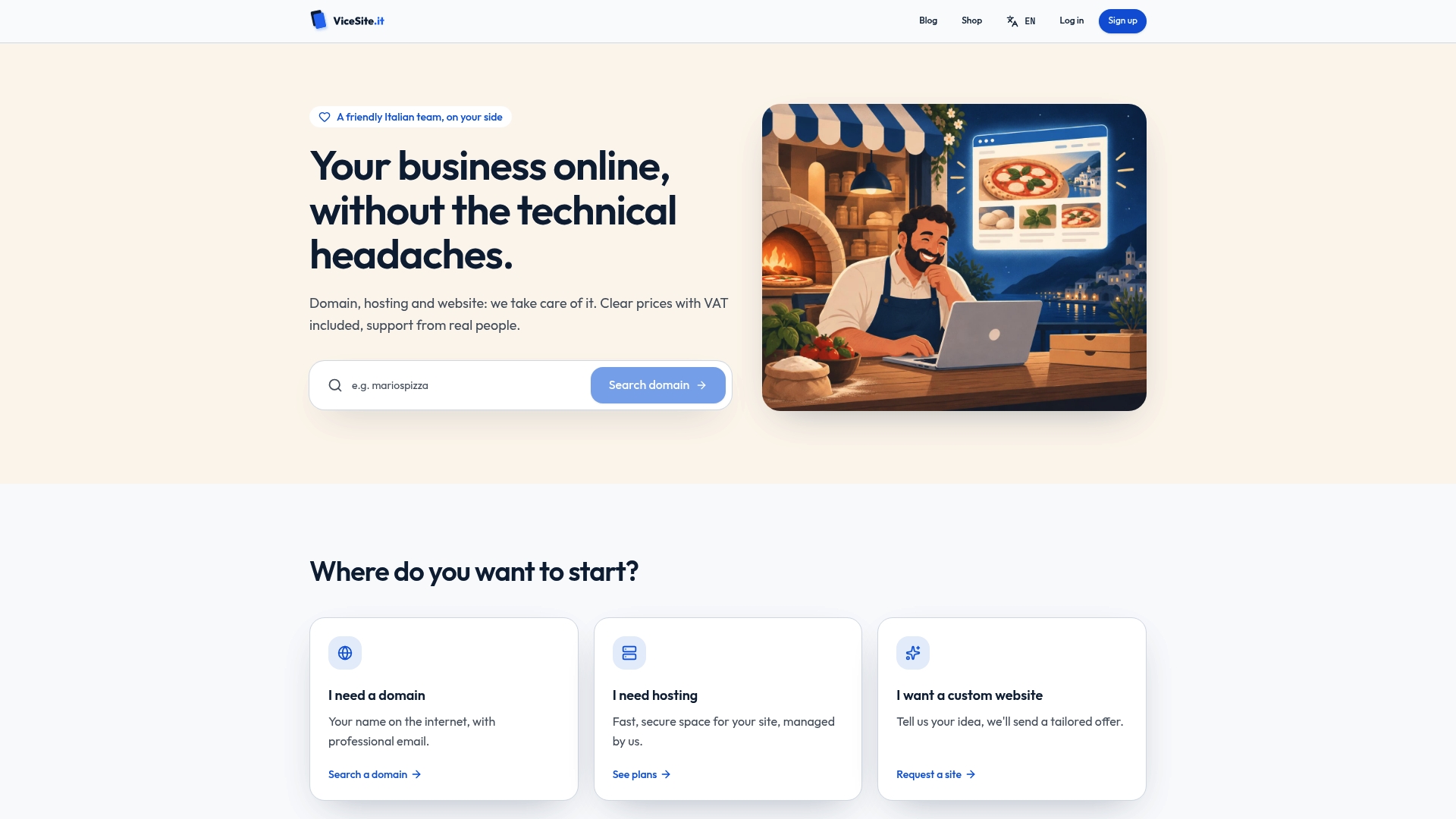
The domain remains yours, with no lock-in, and whenever you have a question, you speak to an Italian team, not a call centre. If you already have a website and just need a reliable place to host it, you can request hosting directly.
Our perspective
People who contact us for a turnkey website almost never ask for “a technology”. They ask us to take it off their minds. They want a website that works, emails that arrive and someone to call when they need help.
That’s why we believe the value of a turnkey service lies not in the number of features, but in three very practical things. The first is clarity: a VAT-inclusive price, with no hidden costs, that you know before paying. The second is freedom: the domain is yours, with no lock-in, because a customer should stay with us because they’re happy, not because they’re trapped. The third is being there: support in Italian from real people, without tickets that get lost.
We built ViceSite around these three ideas because anyone running a business already has enough complications. A website should be a business tool, not another problem to solve.
Sofia
Frequently asked questions
How long does it take to get a turnkey website?
The domain and hosting are activated immediately after payment. The time needed for the website depends mainly on how quickly the copy, logo and photos arrive: with materials ready, a brochure website can be completed much faster. Prepare your content before starting and you’ll shorten the timeline.
Do I own the website and domain?
You should. Check that the domain is registered in your company’s name and that you receive all login credentials at handover. With ViceSite, there is no domain lock-in and it remains yours.
Can I edit the website myself after handover?
With your login credentials, you can update text and images yourself if you wish. However, many small businesses prefer to leave changes to the provider too, to avoid mistakes and save time. Ask in advance how post-launch changes are handled.
What is the difference between a turnkey website and a custom website?
They are not alternatives: “turnkey” describes the service—receiving everything ready to use from a single provider—while “custom” describes the website, designed around your business rather than based on a standard template. The most effective combination for a business is a custom website delivered as a turnkey service.
I already have a domain: can I still get a turnkey website?
Yes. Your existing domain can be connected to the new hosting and website, or transferred so that everything is with a single provider. Email accounts using your domain will continue to work if the migration is carefully planned.
Sources
- Regulation (EU) 2016/679 (GDPR), EUR-Lex
- Cookie regulation in light of the Italian Data Protection Authority’s 2021 guidelines
Recommended
Ready to take your business online?
Search your domain: in two minutes you'll know if it's free and what it costs, VAT included.
Find your domain