
Hosting · Published on November 13, 2026
Hosting for business websites: how to choose the right option
ViceSite · Vicedomini Softworks srl
What hosting is, which type a small business needs, what to check for backups, support and pricing, and how to set it up without technical skills.

For a small business, an independent professional or a startup, the best web hosting is neither the most powerful nor the cheapest. It is the option that keeps your site online, secure and fast, comes with a domain, email and website, and is backed by people who respond in Italian when something goes wrong. That is how we work at ViceSite: a domain, secure hosting and a custom website in one place, with clear VAT-inclusive pricing and an Italian team that works directly with each customer. This guide explains what hosting does, which type a business website actually needs, what to check before signing up and how to get started without writing a single line of code.
At a glance
- Hosting is the space on a server where your website's files live. The domain is the address, and the website is what your customers see: you need all three.
- Good-quality shared or managed hosting is enough for most small businesses. VPS and dedicated servers are for projects with specific traffic levels or technical requirements.
- Free hosting is not up to the job for a business website: no domain of your own, limited control and no one to turn to when problems arise.
- Before choosing, check backups and recovery, HTTPS, support and renewal costs. These are the things that make a difference when your site goes down.
- A single provider for your domain, hosting, email and website means fewer steps, fewer surprise costs and less passing the buck.
Contents
- What hosting does—and what it does not do
- Types of hosting: which does a small business need?
- Free hosting: why it falls short for a business website
- What to check before choosing business hosting
- What hosting for a business website really costs
- How to set up hosting without technical skills
- A domain, hosting and a custom website in one place
- Our perspective
- Frequently asked questions
- Sources
What hosting does—and what it does not do
When someone types in your website's address, their browser requests pages from a computer that is always on and connected to the internet: the server. Hosting is the service that rents you part of that server, providing the file storage, database, processing power and connection your site needs to respond at any time.
The hosting provider takes care of everything beneath the website: maintaining servers, updating system software, protecting the network, keeping backups and stepping in when something breaks. You, or whoever manages the site for you, take care of the content.
Three terms that are often confused:
- Domain: the website's name, for example latuaimpresa.it. You register it for a set period and renew it. Without a domain, no one can find your site.
- Hosting: the physical place where the website lives. Without hosting, the domain points to nothing.
- Website: the pages, text, images and features your customers use. Without a website, hosting is just empty space.
A practical example: the domain is your shop sign, hosting is the rented premises, and the website is the furnishings and products in the window. You can get them from three different providers, but whenever something needs attention, you will have to work out whose responsibility it is. That is why many small businesses choose a single point of contact, and the same reasoning applies to pairing the domain with business email accounts: we discuss this in our guide to domains with professional email.
Types of hosting: which does a small business need?
Hosting plans fall into a few main categories. They differ in how server resources are shared and how much technical work is left to you.
| Type | How it works | Best suited to | Skills required |
|---|---|---|---|
| Shared | Several websites use the same server's resources, each with its own limits | Brochure websites, professional practices, local businesses | None or minimal |
| Managed (for example, for WordPress) | Like shared hosting, but optimised for a platform, with updates and security handled by the provider | Business websites with blogs, catalogues, small online shops | Minimal |
| Cloud | Resources come from multiple servers and can be increased quickly | Websites with seasonal traffic spikes or growing traffic | Intermediate |
| VPS (virtual private server) | A portion of a server reserved for you, with guaranteed resources | Projects with custom software or high traffic | Advanced, unless managed |
| Dedicated | An entire physical server for a single customer | Large online stores, complex applications | Advanced |
For a brochure website, a professional's website or a startup's first site, well-configured shared or managed hosting covers everything you need. Going straight to a VPS often means paying for resources the site does not use and taking on technical responsibilities, such as updates and security configuration, that a small business has no time to handle.
The right question is not “which hosting is the most powerful?” but “which hosting can I use without worrying about it, knowing it can scale as my site grows?” So ask how to upgrade to a higher plan and whether the move involves downtime or migrations you have to handle yourself.
Free hosting: why it falls short for a business website
Services promising a free website always appear among the top search results. They may be enough for a hobby. For a business, you end up paying in other ways:
- No domain of your own. Your site lives on the service's subdomain, such as tuaimpresa.nomeservizio.com, which looks less professional and cannot be taken with you.
- Advertising that is not yours. The service's banners or branding often appear on your pages.
- Strict limits on storage, traffic, email and features, which are only lifted when you switch to a paid plan.
- No guarantees on backups, recovery or response times.
- Difficulty moving elsewhere. Many free platforms do not let you export your entire site: when you decide to switch, you often have to rebuild it.
A business website is a tool for selling and building trust. A domain with your business name, a matching email address and a website that stays online are part of your identity, as we explain in our guide to online branding for small businesses.
What to check before choosing business hosting
Hosting plan descriptions are full of numbers, but six things matter for a small business. For each one, here is what to ask and where people most often go wrong.
Resources and room to grow
Every plan has limits on memory, processing power, databases and traffic. You do not need to understand every detail: you need to know whether your website fits comfortably within them, both today and a year from now, and how to increase resources if needed. A common mistake is choosing the smallest plan to save money, only to discover its limits on the day a campaign brings in visitors.
Security and HTTPS certificates
An SSL certificate enables the padlock and the https:// address, encrypts data exchanged with visitors, such as information submitted through contact forms, and is a basic requirement for a business website. Back in 2014, Google announced that it uses HTTPS as a ranking signal. Check that the certificate is included and renewed automatically, and that the provider protects its servers against attacks and malicious software. We explore these points in our guide to secure hosting for businesses.
Backups and recovery
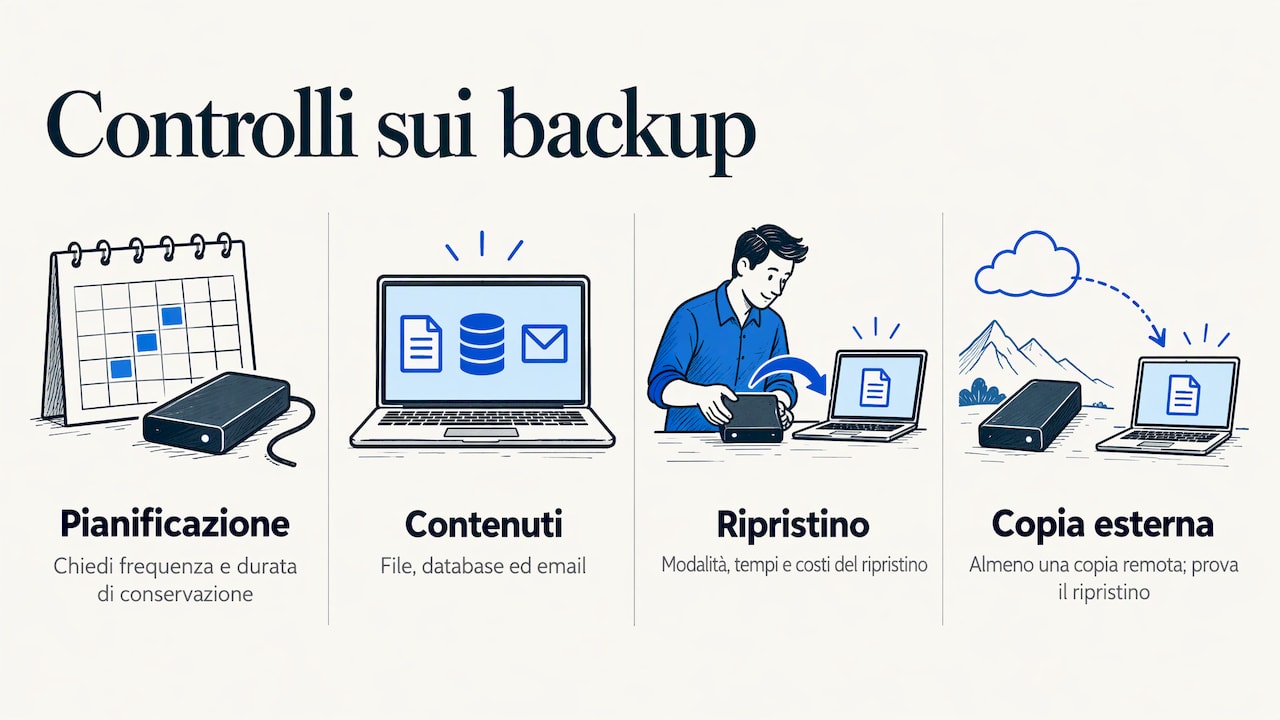
A backup is only useful if it can be restored. Ask four things: how often backups are made, how long they are kept, what they contain (files, databases, email), and how to request a restore, including how long it takes and whether it costs extra. Where backups are stored matters: if they are on the same server as the site, a failure could take out both. To understand how backups fit into a broader business cybersecurity strategy, follow this basic rule: keep at least one copy away from the original site and test recovery before you need it.
Support
This is where the difference between providers becomes clear, usually at the worst possible moment. Ask which channels you can use to reach support, its opening hours, which language it uses and what is included. Distinguish the time to first response from the time to resolution: an automated message within minutes does not fix an offline website. If you do not have an in-house technician, speaking to someone who explains what is happening in plain Italian is worth more than any technical specification.
Pricing, renewals and restrictions
Compare the price you will actually pay, not the headline figure. Check whether VAT is included, how much renewal costs after the initial term, what costs extra (certificate, email, backups, restores, migration) and whether the domain remains yours and can be transferred at any time. A domain tied to a provider locks you in even when you want to switch.
Customer data and GDPR
If your website collects personal data, even just through a contact form, the hosting provider processes that data on your behalf. Article 28 of the EU General Data Protection Regulation (GDPR) requires you to use providers that offer sufficient guarantees and to govern the relationship through a contract. Article 32 requires the ability to restore access to data promptly after an incident. So read the provider's terms of service before buying: ours are publicly available on our terms of service page. For specific questions about how your business processes data, consult your privacy adviser.
What hosting for a business website really costs
The price of hosting depends on the type of plan and what it includes. The total cost over a few years matters more than the headline price. When comparing two offers, put them side by side using this checklist:
| Item | Question to ask |
|---|---|
| Initial term price | Does it include or exclude VAT? |
| Renewal | Does the price stay the same or increase after the first year? |
| Domain | Is it included? Does it remain registered in my name, and can I transfer it? |
| SSL certificate | Is it included, and does it renew automatically? |
| Email accounts | How many are included, and how much storage do they have? |
| Backups and recovery | Are they included? Is there an extra charge for restoring a backup? |
| Support | Is it included, in Italian, with people I can actually reach? |
| Migration | If I already have a website, who moves it and at what cost? |
The three most common surprises for a small business are renewal prices higher than the first year's fee, VAT added only at checkout, and “extras” that everyone actually needs, such as email and backup recovery. Clear, all-inclusive pricing from the start is worth more than an introductory discount.
How to set up hosting without technical skills
Setting up hosting for a business website does not require you to become a systems administrator. It requires making the right decisions in the right order.
- Define what the website needs to do. A brochure site, catalogue, bookings, blog or online sales: the answer determines the type of hosting. The mistake is starting with a plan and adapting the website afterwards.
- Choose and register your domain. Keep it short, easy to spell out over the phone and consistent with your business name. Make sure it is registered in your name. With us, you register your domain without lock-in: it stays yours.
- Choose your hosting plan. Use the checklist in the previous section. If you are unsure between two plans, ask the seller which one your site actually needs: with us, our Italian team answers directly, without call centres or confusing ticket threads.
- Connect your domain, hosting and email. This is where people who buy from different providers get lost in DNS settings and records to change. When your domain and hosting are in the same place, connecting them is part of the service.
- Enable HTTPS and check your backups. Make sure the padlock appears on every page and that you know how to request a restore.
- Publish your website. If you are building it yourself, install your chosen platform. If you prefer a custom website, have it built directly on the hosting you will use: no migrations and one party responsible.
- Keep track of renewals and updates. Note your domain and hosting expiry dates: an expired domain takes both your website and email offline.
Buying from us takes three steps: choose your service, pay securely and your service is activated immediately.
A domain, hosting and a custom website in one place
If you are looking for hosting for your business website, ViceSite has everything you need to get online: domain registration, secure hosting, email account management and custom website design. Pricing is clear and includes VAT, with no hidden costs, and your domain comes without lock-in.
When you have a question, real people from our Italian team answer you directly. Choose your service, pay securely and get started with immediate activation.
Our perspective
People who contact us are usually not looking for hosting. They want a website that works, an email address with their business name and someone to call when something is not right. Hosting is the means, not the goal.
That is why we believe a small business should not have to become an expert in servers, DNS and certificates to build a professional online presence. It should be able to choose, pay and get started, knowing how much it will spend, including VAT, and knowing that its domain remains its own.
The hosting market often speaks a technical language full of acronyms, limits and costs that only emerge later. We have chosen the opposite approach: domains, secure hosting, email and custom websites in one place, with support in Italian from real people, without call centres or tickets going round in circles.
The advice we give everyone is simple: choose a provider you would trust even on your website's worst day. That is when you find out what your hosting is really worth.
Sofia
Frequently asked questions
How much does hosting for a business website cost?
It depends on the type of plan and what it includes: the domain, SSL certificate, email, backups and support may be included or charged separately. To compare two offers, look at the total cost over several years, including VAT and renewals. Our published prices include VAT, with no hidden costs.
Can I use free hosting for my business?
It is not recommended for a business website: you usually cannot use your own domain, the service's branding or advertising appears on your pages, and there are no guarantees for backups or support. Moving the site elsewhere may also mean rebuilding it. Professional hosting with your own domain conveys reliability from the very first click.
What is the difference between hosting and a domain?
The domain is your website's address; hosting is the space on the server where the website lives. You need both, and they must be connected. Buying them together simplifies setup and gives you a single point of contact.
Can I switch hosting if I already have a website?
Yes, as long as the domain is registered in your name and can be transferred, and you can obtain a complete copy of the website. Before switching, check who handles the move and how email will be managed during the transition. If you are unsure, ask our Italian team how to proceed.
Sources
Recommended reading
Ready to take your business online?
Search your domain: in two minutes you'll know if it's free and what it costs, VAT included.
Find your domain