Hosting · Published on November 19, 2026
How to choose hosting for your business website: 2026 guide
ViceSite · Vicedomini Softworks srl
How to choose hosting for your business: plan types, reliability, backups, Italian-language support and contract terms to check before you pay.

Choosing the right hosting for a small business takes three things: a plan that matches your website’s expected traffic, clear commitments on backups and security, and Italian-language support you can turn to without knowing the technical jargon. Technical specifications matter, but if you don’t have an IT specialist in your business, your first priorities should be who responds when something stops working and what the service will actually cost at renewal. That’s why we at ViceSite offer secure hosting with VAT-inclusive prices, no domain lock-in and support from real people. This guide covers the criteria to compare, the terms to read and a five-step process to help you make the right choice.
At a glance
- Choose based on your project, not the lowest price: quality shared hosting is usually enough for a brochure website or small online store, while dedicated servers are for websites with very high traffic.
- Think about tomorrow’s traffic: size your plan for what your website will be doing in a year, not what it does today.
- Backups and recovery are your real insurance policy: ask how often backups are made, how long they remain available and who will help you restore them.
- Italian-language support matters as much as gigabytes: without an in-house technical contact, the speed and clarity of support determine how long a problem lasts.
- Read the renewal price and domain terms: VAT-inclusive pricing, no hidden costs and the freedom to transfer your domain are the three things to check before paying.
Contents
- What hosting is and why your choice matters to your business
- What type of hosting a small business needs
- How to recognise reliable hosting
- Hosting support in Italian: what to check
- Contracts, renewals and domains: the terms to read
- Free or paid hosting for a business
- How to choose in practice: five steps
- Our perspective
- ViceSite hosting for your business
- Frequently asked questions
- Sources
What hosting is and why your choice matters to your business
Hosting is space on a server—a computer that is always on and connected to the Internet—where your website’s files, images and database live. When a customer types in your address, that server sends them the page. If you’d like a refresher on the basics, we’ve explained what web hosting is and how it connects to your domain in detail.
For a business, hosting is not just a technical detail: it determines how quickly pages open, whether your website stays accessible when it matters, how customer data is protected and, very often, how the email accounts on your domain work. A slow or unavailable website during an advertising campaign or a sales period is a real cost, not just an inconvenience.
What type of hosting a small business needs
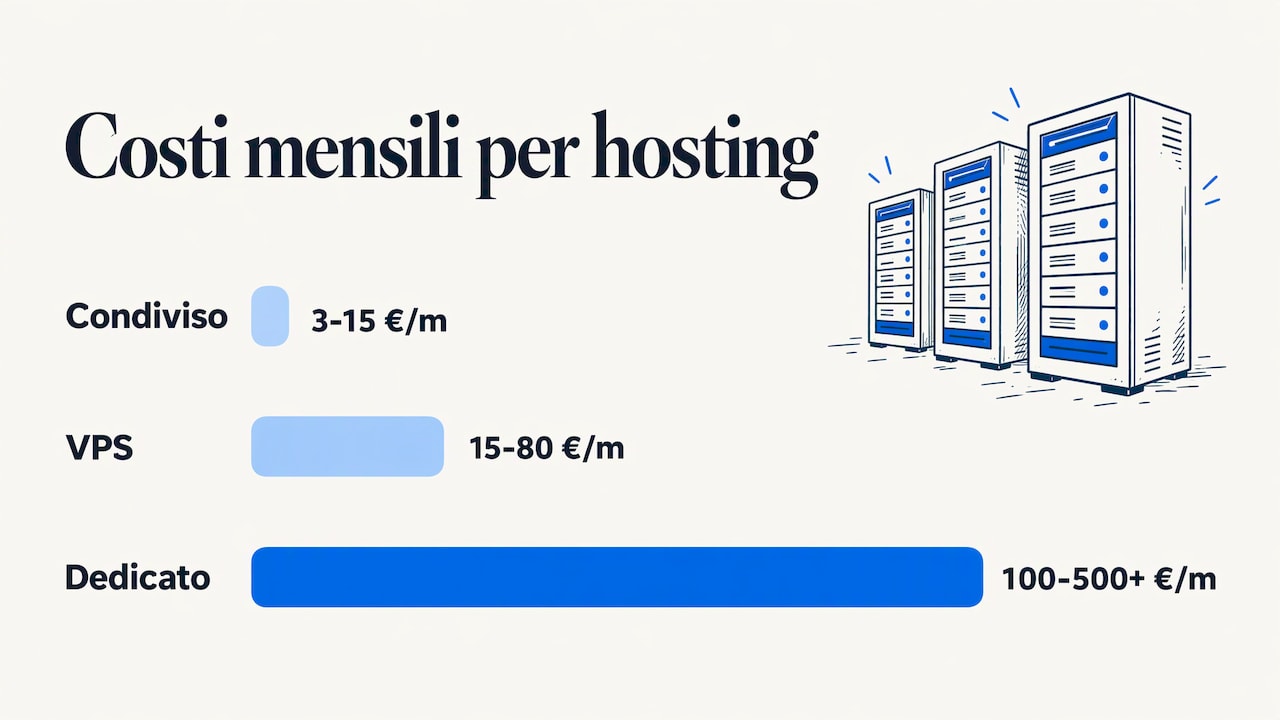
The first consideration is the right fit: your plan needs to handle expected traffic, not just current traffic. An Italian guide to e-commerce hosting published in 2026 gives these approximate price and traffic ranges for the main types:
| Hosting type | Who it’s for | Approximate traffic | Approximate cost (2026) |
|---|---|---|---|
| Shared | Brochure websites, blogs, newly launched online stores | Up to 5,000–10,000 visits per month | €3–15 per month |
| VPS (virtual private server) | Growing online stores | 10,000–80,000 visits per month | €15–80 per month |
| Dedicated server | Websites with very high traffic | Over 100,000 visits per month | €100–500 per month and upwards |
| Cloud | Projects with sudden spikes or rapid growth | Variable, scales with demand | €20–100 per month or pay-as-you-go |
Let’s clarify three terms. With shared hosting, multiple websites use the resources of the same server, which is fully managed by the provider: it’s the simplest option and suits the vast majority of websites for professionals, practices, shops and startups. A VPS is a portion of a server reserved for you, with more power but also more configuration to handle. Cloud hosting distributes your website across multiple machines and increases resources when traffic spikes.
For a business website, a professional portfolio or a startup’s first brochure website, well-managed shared hosting covers your needs with room to spare. The same guide stresses that an online store expecting to grow fivefold in twelve months needs to choose a service that can handle future demand or can be expanded easily. So the right question to ask your provider is: “If my website grows, how do I move to the next plan, and what will it cost?”
How to recognise reliable hosting
You can recognise reliable business hosting by what the provider puts in writing. Here are the points to compare, in order of importance for anyone without an in-house technician.
Availability (uptime): look closely at the percentage
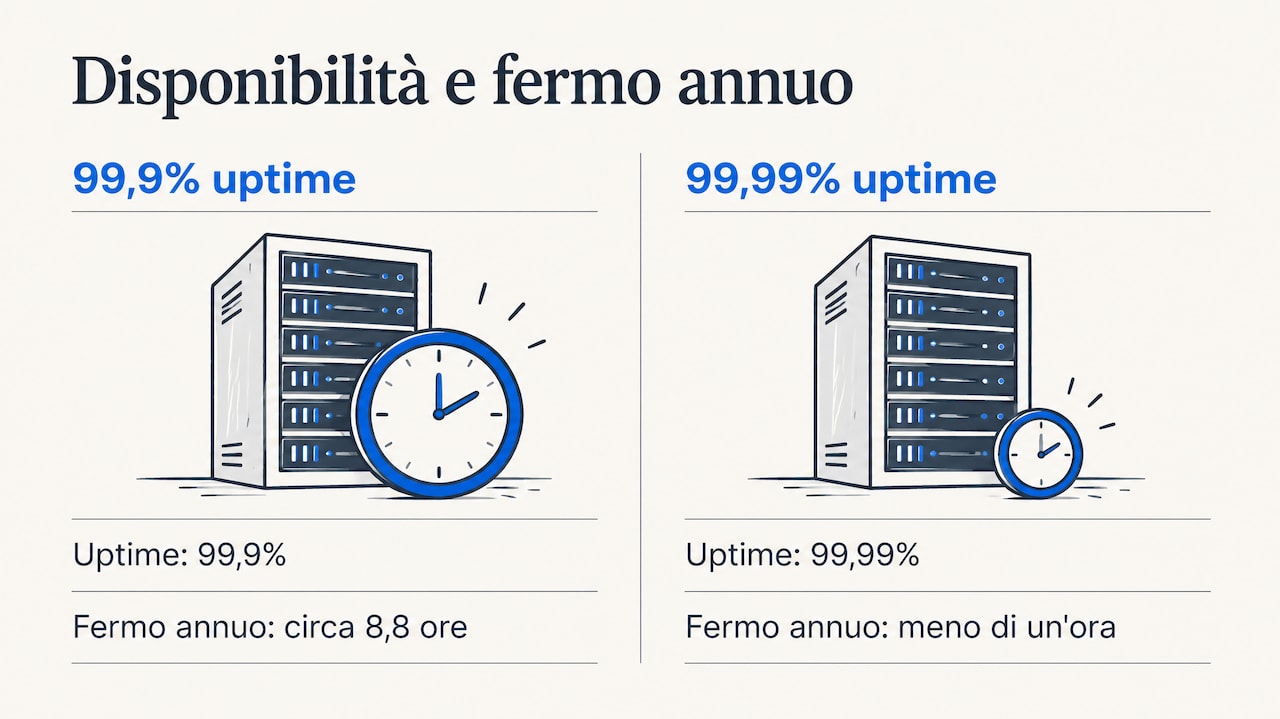
Uptime is the percentage of time the server is accessible. The figures always look very high, but it helps to convert them into hours: a year has 8,760 hours, so 99.9% uptime allows around 8.8 hours of downtime per year, while 99.99% allows less than one hour. Beyond the number, check how it is measured, which interruptions are excluded (such as scheduled maintenance) and what you receive if the promise is not met. This document is called an SLA (Service Level Agreement).
Speed and performance
Speed depends on both your website and the server. On the hosting side, useful features to compare include SSD drives (much faster than traditional drives), guaranteed resources rather than just “up to” figures, an up-to-date version of PHP (the language that powers WordPress and many other websites) and caching systems, which store ready-made pages to serve them faster. A fast website is more enjoyable to visit and also helps in search results, because Google considers the browsing experience. Be wary, however, of plans sold as “SEO hosting”: no plan alone guarantees good rankings, which depend mainly on your website’s content and structure.
Backups and recovery
This is the feature people overlook until they need it. Ask four things: how often backups are made (ideally daily), how many days they remain available, whether they are stored separately from the main server and how your website is restored. Recovery is the critical moment: knowing someone will guide you step by step, or do it for you, is worth more than any promise about backup frequency.
Security
Secure hosting includes, at a minimum, an SSL certificate (the padlock in the browser, which encrypts data between the website and its visitor), protection against attacks and malware, and regular server updates. Also clarify who is responsible for what: the provider protects the server, but who updates the website, plugins and passwords? We’ve gathered all the checks in a guide to what secure hosting should guarantee for businesses.
Server location and personal data
If your audience is in Italy, servers in Italy or elsewhere in Europe reduce response times. There’s also the question of data: your website collects contact details, orders and form submissions, and personal data is protected by the GDPR, the European privacy regulation. Always ask your provider where the servers and backups are physically located: you also need this information for your website’s privacy notice. For questions about your specific obligations, consult your business’s privacy adviser or lawyer.
Email on your own domain
For many small businesses, hosting comes with email accounts. Check how many are included, how much storage they have and whether you can manage them easily. An address such as info@tuaazienda.it conveys professionalism: you can find out how to set one up in our guide to a domain with professional email.
Hosting support in Italian: what to check
For a business without a technical contact, support is the criterion that determines everything else. When your website won’t load or an email account stops receiving messages, the number of gigabytes you have doesn’t matter: what matters is how quickly a knowledgeable person understands the problem and fixes it. The industry guide mentioned above sums it up like this: technical support is the difference between 15 minutes of downtime and 4 hours.
Before choosing, clarify:
- Language and people: will an Italian team respond, or a call centre following a script? Can you explain the problem in your own words, or do you need to know the technical terms?
- Channels and hours: phone, email, chat; on which days and at what times.
- Tickets or direct contact: a ticket system can pass the same request between several agents, while direct contact shortens response times.
- What’s covered: just the server, or help with email, your domain and website configuration too? When a plan is described as “managed”, ask what that means in practice.
- What happens in emergencies: who steps in if your website is unavailable, and how quickly.
Support levels vary widely depending on the infrastructure. Businesses already working on large cloud platforms, for example, often entrust day-to-day server management to dedicated teams and can start with an AWS optimisation score to understand the state of their setup. For a business website, portfolio or small online shop, however, what you need is simpler: someone who responds in Italian, understands straight away and solves the problem.
Contracts, renewals and domains: the terms to read
Many disappointments come from the contract, not the server. Before activating your hosting, check these points:
- Renewal price: many offers show a promotional price for the first year. Ask what you’ll pay from the second year onwards and compare costs over three years, not twelve months.
- VAT included or excluded: a price marked “+ VAT” costs 22% more. Always compare final amounts.
- Term and commitments: check the minimum term, automatic renewal and cancellation notice period.
- Domain ownership and transfer: the domain must be registered in your name, and you must be able to move it whenever you want, receiving the transfer code without obstacles. A “locked-in” domain ties you to the provider even when you’re unhappy.
- Additional services: are the SSL certificate, backups, email accounts and website migration included, or do they cost extra? These are the items where hidden costs most often appear.
- Migration: if you already have a website, ask who handles the move and whether it’s included.
If you’re still deciding on your business’s online name, also read how to choose a domain name: domains and hosting are bought together, so it makes sense to consider them together.
Free or paid hosting for a business
Free services exist, but they are designed for testing and personal projects. They usually require a third-level address (such as yourbusiness.servicename.com instead of yourbusiness.it), limited storage, third-party advertising on your pages and few customisation options. For a business, the result is an unprofessional image and a website you don’t fully control, while legal obligations, such as the privacy notice, remain your responsibility.
Paid hosting gives you your own domain, professional email, backups, security and someone to ask for help. Based on the shared hosting price ranges above, a business website involves a modest annual expense compared with the value of a customer gained online.
How to choose in practice: five steps
- Describe your website in three lines. What it needs to do (present your business, collect enquiries, sell), how many pages it will have and how many visits you expect in a year. This is the basis for choosing your plan. The typical mistake is starting with the pricing table rather than the project. If you also need a website, we can build it to your specifications and choose the plan alongside the project.
- Choose the hosting type. For brochure websites, portfolios, blogs and small online shops, choose quality shared hosting. If you expect strong growth, ask straight away how to move to the next level. The mistake here is buying too much, or too little, out of fear of getting it wrong.
- Verify reliability and security in writing. Uptime, daily backups, SSL, server location. If something isn’t written down, ask for it. Our hosting plans are designed to provide secure hosting for businesses, and you can ask us about every detail before activating them.
- Test support before buying. Ask a simple question in your own words, and see who replies, how long it takes and whether the answer is clear. With us, real people from our Italian team respond, with no call centres or confusing ticket hand-offs.
- Compare the total cost and domain terms. VAT-inclusive pricing, renewal, included services and the freedom to transfer your domain. At ViceSite, prices include VAT, with no hidden costs and no domain lock-in. Activation then follows three steps: choose your service, pay securely and your service is activated immediately.
For a closer look at business websites specifically, you’ll find more examples in our guide to choosing hosting for business websites.
Our perspective
People who contact us to choose hosting usually don’t want to become server experts. They want a website that works, emails that arrive and someone to call when needed. That’s why we believe that, for a small business, a professional or a startup, the choice starts with three simple questions: who will respond, what will I actually pay, and will my domain remain mine?
We built ViceSite around those answers. Real support in Italian from real people, with no call centres and no tickets passed from person to person. Clear prices, including VAT, with no hidden costs. No domain lock-in. And a three-step process: choose, pay securely, and your service is activated immediately.
Technical specifications are important, and we take care of them. But for someone running a business, what makes the difference is knowing there’s someone on the other end who speaks your language without jargon, and that your domain, hosting, email and website can all be in one place.
Sofia
ViceSite hosting for your business
If you want secure hosting with clear VAT-inclusive prices, no domain lock-in and an Italian team to support you, you can activate it directly with us. Alongside hosting, we can register your domain, set up your email accounts and build your custom website.
Choose your service, complete your secure payment and the service is activated immediately: request your hosting or explore all the services on ViceSite.
Frequently asked questions
How much should hosting for a business website cost?
It depends on the type of plan. According to a 2026 industry guide, shared hosting, which suits most brochure websites and small online stores, costs roughly €3–15 per month, while VPS plans and dedicated servers cost more. Always compare VAT-inclusive prices and renewal costs, not just the first year.
What does 99.9% uptime mean?
It means the server may be unavailable for around 0.1% of the time, or almost 9 hours in a year. Beyond the percentage, read how it is measured, which interruptions are excluded and what the contract provides if it is not met.
Can I change hosting without losing my domain?
Yes, if the domain is registered in your name and the provider doesn’t lock it in. In that case, you can request the transfer code and move it. At ViceSite, there is no domain lock-in: it remains yours.
Do I need hosting with Italian-language support?
If your business doesn’t have a technician, yes: when something stops working, you need to be able to explain the problem in your own words and get a clear answer quickly. Before choosing, check the channels, hours and whether you’ll get a response from people or a ticket system.
Do hosting and a domain have to be bought together?
It’s not compulsory, but it’s the simplest choice for a small business: one provider, one support team and no configuration needed to connect separate services. If you still need to find a name, first check that the domain is available, then activate your domain and hosting at the same time.
Sources
Recommended reading
Ready to take your business online?
Search your domain: in two minutes you'll know if it's free and what it costs, VAT included.
Find your domain