
Domains · Published on November 10, 2026
What is a domain? A clear guide for business owners
ViceSite · Vicedomini Softworks srl
What an internet domain is, how it works, who owns it and how to choose one for your business: explained without jargon, with examples and mistakes to avoid.

A domain is the name people use to find your business online: the address customers type into their browser (for example, pasticceriarossi.it) and that also appears in your emails (info@pasticceriarossi.it). Behind it is a numerical address that nobody would remember. The name makes it easy to recall. For a business, a domain is a distinctive identifier, like the sign above your shop. So it makes sense to register it in your own name, with a provider that connects it straight away to your website and email, and answers you in Italian when something goes wrong. That's exactly how we work at ViceSite: domains, hosting and custom websites together, with clear VAT-inclusive prices and no domain lock-in.
At a glance
- A domain is your website's name on the internet: it turns a numerical address (IP) into words through the DNS system.
- It has several levels: in www.nomescelto.it, “.it” is the top level, “nomescelto” the second level and “www” the third.
- A domain is not a website: to put it to use, you need hosting (the space where your website lives) and, if you want, email accounts.
- It lasts one year and must be renewed: if it expires, anyone can register it after a short period.
- The person listed as the “registrant” is the domain holder: make sure this is your business, not whoever built your website.
Contents
- Domains explained in plain English
- How a domain is structured: the parts of the name
- Domain, hosting, website and email: what each one does
- Who owns a domain?
- How to find your domain and check who it is registered to
- How long a domain lasts and what happens if it expires
- How to choose the right name for your business
- Registering a domain: the steps
- Domain, hosting and website in one place
- Our perspective
- Frequently asked questions
- Sources
Domains explained in plain English
Every computer connected to the internet, including the servers that host websites, has an IP address: a sequence of numbers. Remembering numbers like these for every website would be impossible. That's why domain names were created: as Registro .it explains, a domain simplifies the sequence of digits in an IP address by linking it to a text-based name that's easier to remember.
The “translation” is handled by DNS (Domain Name System), which you can think of as the internet's address book. When a customer types your address into their browser, DNS looks up the corresponding number and takes them to the right server in a fraction of a second. According to ICANN, the organisation that coordinates domain names worldwide, 12 independent operators with over 1,000 servers work at the root of this address book.
Here's a useful detail: a single domain can point to multiple addresses, depending on the services connected to it. The Registro .it page on DNS explains that your website and email, for example, can live on different servers while using the same name. That's why a properly configured domain keeps your website, email and other services working together.
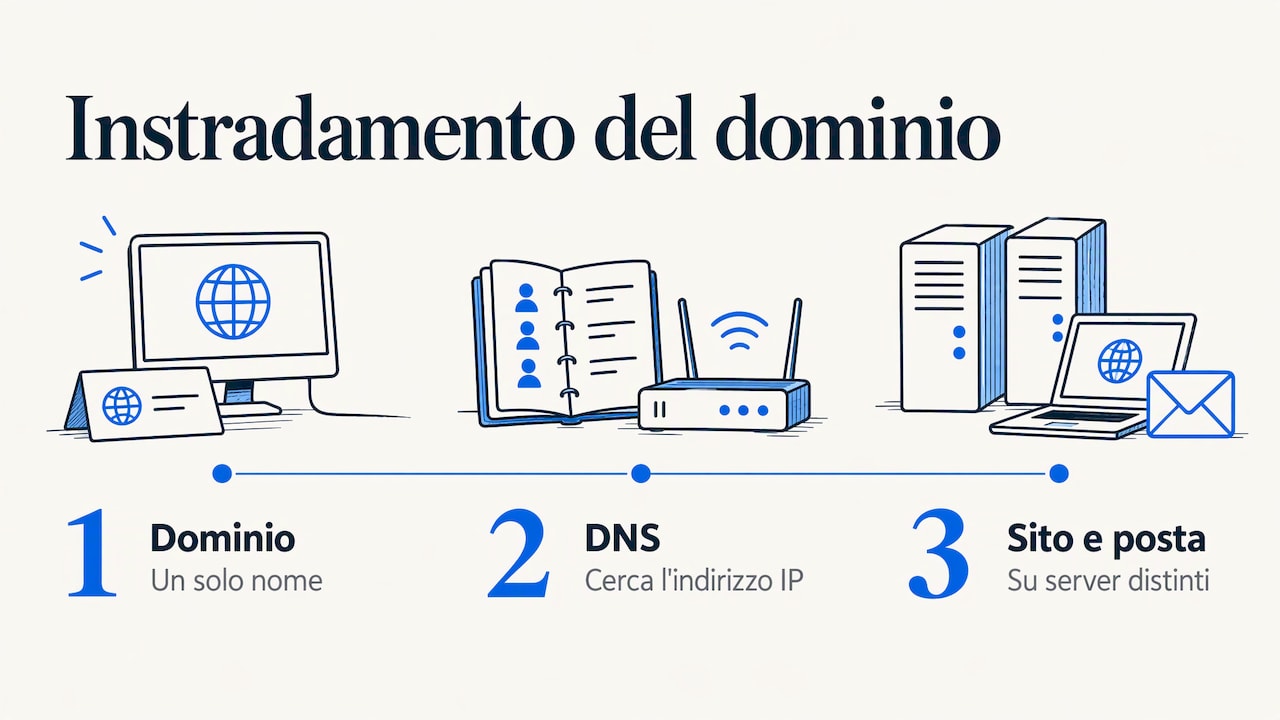
For a business, a domain is also an identity. The Treccani entry on domains describes it as a unique name on the internet for individuals, businesses and organisations: two identical domains cannot exist, and whoever registers a name first gets it.
How a domain is structured: the parts of the name
A domain is read from right to left, from the most general level to the most specific. Registro .it uses this example:
| Part | Example in www.nomescelto.it | What it indicates |
|---|---|---|
| Top level (TLD) | .it | The extension: the country or category |
| Second level | nomescelto | The name you choose and register |
| Third level (subdomain) | www | A section or service of the website |
Extensions (TLDs, top-level domains) fall into three groups, again according to the Registro .it press kit:
- ccTLDs, two-letter country-code extensions, such as .it or .eu. The .it extension was recognised in December 1987, and the first Italian domain was cnr.it.
- gTLDs, generic extensions of at least three letters, such as .com or .net, not tied to a country.
- New gTLDs, more recent, themed extensions, such as .paris or .xyz.
The second level is the part that matters most to you: it usually reflects the name of your business, brand or service. Subdomains, on the other hand, can be created freely after registration, without buying a new domain: shop.tuonome.it for an online shop or prenota.tuonome.it for a booking system are typical examples.
The .it extension remains the go-to choice for businesses serving Italian customers: by the end of 2025, there were 3,537,551 registered .it domains, up from the previous year.
Domain, hosting, website and email: what each one does
This is the most common source of confusion for anyone getting online for the first time. ICANN makes clear that a domain name is not the same as a website: once registered, it needs other services, such as hosting or email, to be useful. Registro .it uses a helpful analogy: your website is your “virtual home”, and your domain is the address where customers find you.
| Element | Real-world comparison | What it's for |
|---|---|---|
| Domain | Address and shop sign | Helping people find you through a recognisable name |
| Hosting | Rented premises | Storing your website files and keeping it online |
| Website | Furnishings and shop window | Presenting your business and winning customers over |
| Email on your domain | Letterbox | Communicating through a professional address |
All four parts need to work together: the domain must point to the right hosting, email needs the correct DNS records, and the website must work both with and without “www”. When you buy them from different providers, every change means figuring out who manages what. For more on the technical side, read our guides to what web hosting is and domains with professional email.
Who owns a domain?
Technically, you don't buy a domain forever: you register it for a set period and get exclusive use of it as long as you keep renewing it. The person who registers it is called the registrant: the Registro .it regulations define this as whoever requests or has obtained registration of the name. The registrant, and only the registrant, has legal control over the domain.
There are three other parties involved:
- The registry, which manages an extension. For .it, this is Registro .it, run by the CNR's Institute of Informatics and Telematics in Pisa.
- The registrar, the accredited company that registers the domain on your behalf. According to Registro .it data, there were around 1,200 accredited registrars in Italy in 2019.
- The provider you deal with directly, which is often also the registrar.
Here's the tricky part for a small business: sometimes the domain is registered in the name of the agency or consultant who built the website. As long as the relationship works, nobody notices; when you want to change providers, it turns out the domain isn't yours. Changes of registrant and transfers require the AuthInfo code, a kind of domain password, as explained in Registro .it's “Domains and beyond” guide.
There's also a legal aspect. Italy's Industrial Property Code (Legislative Decree 30/2005, Article 22) places domain names on a par with other distinctive business identifiers, such as trade names and shop signs: as Treccani summarises, registering a domain name that matches someone else's registered trademark is prohibited. This protects your brand, but it works both ways: before choosing a name, check that it doesn't match another party's trademark. If you're unsure about a specific case, an industrial property consultant or lawyer is the right person to ask.
How to find your domain and check who it is registered to
If you already have a website, your domain is the part of the address after “www.” or after the @ in your business email addresses. Finding it is easy; checking who it is registered to takes one more step.
For .it domains, Registro .it maintains the database of assigned names, which you can search using the whois service on its website. Enter the full name (without “www”) and check:
- Registrant: this should be your company or you as the business owner;
- Registrar: the company through which the domain is registered;
- Expiry date: when it needs to be renewed.
If you are not the registrant, ask whoever registered the domain to start a change of registrant and give you the AuthInfo code. This is something to check today, not on the day you need it.
How long a domain lasts and what happens if it expires
Registration lasts one year and must be renewed. Registro .it describes what happens if the renewal isn't paid: the provider disables the service and, after expiry, the domain becomes available to anyone again, with the data permanently deleted. Many providers allow reactivation within around 7 days, but this is not guaranteed.
For a business, the consequences are very real: the website stops loading, emails stop arriving and, in the worst case, someone else registers the name your customers know. Three habits can prevent this:
- keep the email address linked to the domain up to date, because that's where expiry notices are sent;
- put the renewal date in your business calendar;
- choose a provider that actually responds when you have a question about renewal.
How to choose the right name for your business
Registro .it sets out some rules for .it domains in its registration guide:
- between 3 and 63 characters;
- letters (including accented letters), digits and hyphens;
- no hyphen at the beginning or end;
- registration is open to those with citizenship, residence or a registered office in the European Economic Area, Vatican City, San Marino or Switzerland.
Beyond the rules, there's good business sense. A good domain for a small business:
- matches or closely resembles the business name, so people looking for you can guess it;
- is short and easy to say over the phone: if you have to explain how to spell it, it's too complicated;
- avoids unnecessary hyphens and numbers, which are easy to forget;
- uses the extension your audience expects: .it for businesses operating in Italy, perhaps alongside a .com or .eu to protect the name;
- doesn't use someone else's trademark, for the legal reasons discussed above.
For example, a garage called “Autoriparazioni Bianchi” in Verona might consider officinabianchi.it or bianchiverona.it, which are easier to remember than autoriparazioni-bianchi-verona.it. If the name you want is already taken, adding your city or main service is often the most natural solution. Choosing a domain is the first step in online branding for small businesses: your name, logo, website and email should all convey the same identity.
Registering a domain: the steps
- Check availability. Search for the name with your preferred extension. A common mistake: falling in love with a single name without preparing alternatives.
- Check trademarks. Make sure the name doesn't match someone else's registered trademark.
- Register the domain in your business's name. The registrant details must be those of the company or business owner. This is where the ownership problems discussed above arise; with us, there's no domain lock-in.
- Connect hosting and email. A domain alone doesn't display anything: it needs to point to your hosting and be configured for email. Doing it yourself means editing DNS records; with one provider for your domain, hosting and email accounts, connecting them is part of the service.
- Publish your website. A domain becomes useful when there's something to show: a clear page explaining who you are, what you offer and how to contact you.
- Renew every year. Keep an eye on the expiry date and payment method.
Domain, hosting and website in one place
With ViceSite, you can register your domain, activate secure hosting and, if you'd like, have us build a custom website, with email accounts managed by us. There are three steps: choose your service, pay securely and get instant activation. Prices are clear and include VAT, with no hidden costs, and when you have a question, an Italian team answers you, not a call centre.
Explore the services at ViceSite: domains, hosting and websites for SMEs or, if you already have a domain and need reliable hosting space, request your hosting. To understand what a professional service should provide, also read our guide to secure hosting for businesses.
Our perspective
People who contact us for the first time usually don't want to know what a DNS record is: they want their website to load, their emails to arrive and their business name to remain theirs. They're right. A domain is a small part of an online presence, but it's the foundation for everything else.
That's why we believe domains, hosting, websites and email should be treated as one, with a single point of contact. Every handover between different providers is a chance for a setting, a renewal or a transfer code to get lost.
Our commitment is simple: clear prices including VAT, no domain lock-in and real people who answer in Italian. Your business name is your distinctive identifier, and it should stay in your hands.
Sofia
Frequently asked questions
What's the difference between a domain and an IP address?
An IP address is the number that identifies a server on the internet; a domain is the name that represents it in a readable form. DNS connects the two, so customers can type a name and reach the right server without needing to know any numbers.
Can I have a domain without a website?
Yes, you can register a domain simply to protect your business name or use it for professional email. To publish a website, though, you also need hosting and the website pages themselves.
What is a company's domain?
It's the domain name registered in the company's name, usually reflecting its business name or brand and appearing in its website and email addresses. Italian law considers it a distinctive business identifier, on a par with a trade name or shop sign.
How much does a domain cost?
The cost varies depending on the extension and provider, and is paid each year at renewal. When comparing offers, check whether VAT is included and how much renewal costs after the first year: our prices are transparent and already include VAT.
Can I move my domain from one provider to another?
Yes, if you are the registrant. Transferring a .it domain requires the AuthInfo code, which your current provider must give you; with the domain registered in your name, changing providers remains your choice.
Sources
Registro .it, How domains and domain names work (2019 press kit) Registro .it, DNS: everything you need to know Registro .it, Domains and beyond: 7 things to know before registering a domain Registro .it, Website (Digital kit 2020) Registro .it, Quarter .it: the final four months of 2025 Registro .it, Regulations for the assignment and management of domain names in the .it ccTLD Registro .it, Assigned Names Database Policy ICANN, Root server system (infographic, 2024) ICANN, About domain names Treccani, Domain (21st-century lexicon)
Recommended reading
Ready to take your business online?
Search your domain: in two minutes you'll know if it's free and what it costs, VAT included.
Find your domain