
Domains · Published on November 16, 2026
How to choose a domain name for your business
ViceSite · Vicedomini Softworks srl
How to choose a business domain name: Registro .it guidelines, .it or .com, trademark and availability checks, mistakes to avoid, and registration.

The right domain name for a business is short, easy to dictate over the phone, matches the business name, and stays relevant for years. What you need is a method, rather than a flash of inspiration. First, choose the name using clear criteria. Then check that it is available and does not infringe someone else’s trademark. Finally, register it so that it stays yours, in your name, with a provider that lets you move it elsewhere. That last step determines whether your domain becomes an asset for your business or a problem. Here you’ll find the complete method: the official Registro .it guidelines, choosing an extension, the checks to run, and costly mistakes to avoid.
At a glance
- Your name is a branding choice, not an SEO trick: according to Google’s team, putting keywords in a domain does not provide a tangible ranking advantage.
- Short, singular, with no hyphens or accents: these are some of the 10 guidelines Registro .it itself suggests for a name that is easy to remember and type.
- For businesses operating in Italy, .it is the natural choice: by the end of April 2026, there were more than 3.5 million registered .it domains.
- Check availability and trademarks before investing: a domain cannot be reserved and is assigned on a first-come, first-served basis.
- Register it so that it stays yours: the registrant is responsible for the domain, so who it is registered to and how freely you can move it matter.
Contents
- Your domain is your business name online
- Registro .it’s 10 guidelines for choosing a name
- Business name or keyword?
- Which extension to choose: .it, .com, or something else
- The .it rules in brief
- How to check that a name is genuinely available
- How to register a .it domain
- The most costly mistakes
- Your domain with ViceSite
- Our perspective
- Frequently asked questions
- Sources
Your domain is your business name online
Your domain name is the address customers type to find you (for example, pasticceriarossi.it) and the part after the @ sign in your professional email addresses. You’ll print it on business cards, vans, invoices, and quotes. Changing it a few years later means redoing all of this, notifying customers, and rebuilding your website’s visibility.
That is why it pays to think long-term from day one. In its DOT report from early 2026, Registro .it, the organisation that manages the registry of Italian domains, also describes domain renewal as a sign of continuity: a name renewed year after year is a name that has retained its value. A good domain chosen today is one you’ll be happy to renew in ten years.
If you want to understand how your domain fits into your business’s overall identity—name, logo, tone, and channels—you’ll find more detail in our guide to online branding for small businesses.
Registro .it’s 10 guidelines for choosing a name
Registro .it has published a list of guidelines for choosing a name that serves as a practical checklist. Here they are, explained with concrete business examples.
| Guideline | What it means in practice |
|---|---|
| Check that it does not already exist | Before falling in love with a name, check that it is available |
| Match the domain to the website name | If the website is called “Studio Bianchi”, the domain is studiobianchi.it |
| Keep the length reasonable | The technical limit is 63 characters, but a short name is easier to remember |
| No hyphens | They can be confused with underscores and are awkward to dictate |
| No accented letters | Many people type them without the accent and end up elsewhere |
| Singular rather than plural | fioreria (flower shop) is easier to remember than fiorerie (flower shops) |
| Specific names, not generic ones | ceramichevietri.it says more than ceramiche.it |
| Try two words | A surname plus the type of business often works: ottica- becomes otticaverdi |
| Avoid fads and trends | Today’s slang may sound dated in three years |
| Keep the risk of typos low | No confusion between 0 and O, and no commonly misspelled words |
The phone test
One simple test sums up half the list: say the domain aloud to someone without showing it to them, and ask them to write it down. If you have to add “with a hyphen”, “without the accent”, or “zero, not the letter O”, the name has failed the test. Every extra explanation means a customer could type the wrong address or send an email that never arrives.
How short should it be?
There is no magic length, but the rule of thumb is: as short as possible without losing clarity. A three-letter abbreviation is short but tells people who do not know you nothing; a thirty-character name is clear but nobody remembers it. For most small businesses, the sweet spot is the business name as people say it, perhaps with a word indicating the sector or city.
Business name or keyword?
It is the question we hear most often: is rossiidraulica.it or idraulicomilano.it better? The short answer is: your business name, perhaps with a reference to your sector.
Google’s Search Relations team settled the issue in a 2023 interview: asked whether a domain with a keyword in its extension offered ranking benefits, Gary Illyes gave a firm no, describing domain selection as a branding decision rather than an SEO decision. Rankings depend on your website’s content, its technical quality, and the reputation you build over time.
There are also practical reasons to prefer your business name:
- It can be protected: a distinctive name can be linked to a trademark; a generic word cannot.
- It grows with you: if today you only do plumbing in Milan, but tomorrow you open in Monza or add heating services, idraulicomilano.it becomes limiting.
- It inspires trust: a customer receiving an email from info@rossiidraulica.it immediately recognises who is writing.
A word describing your sector is still useful when the name alone is ambiguous or already taken: bianchiarredamenti.it is clear, short, and distinctive all at once.
Which extension to choose: .it, .com, or something else
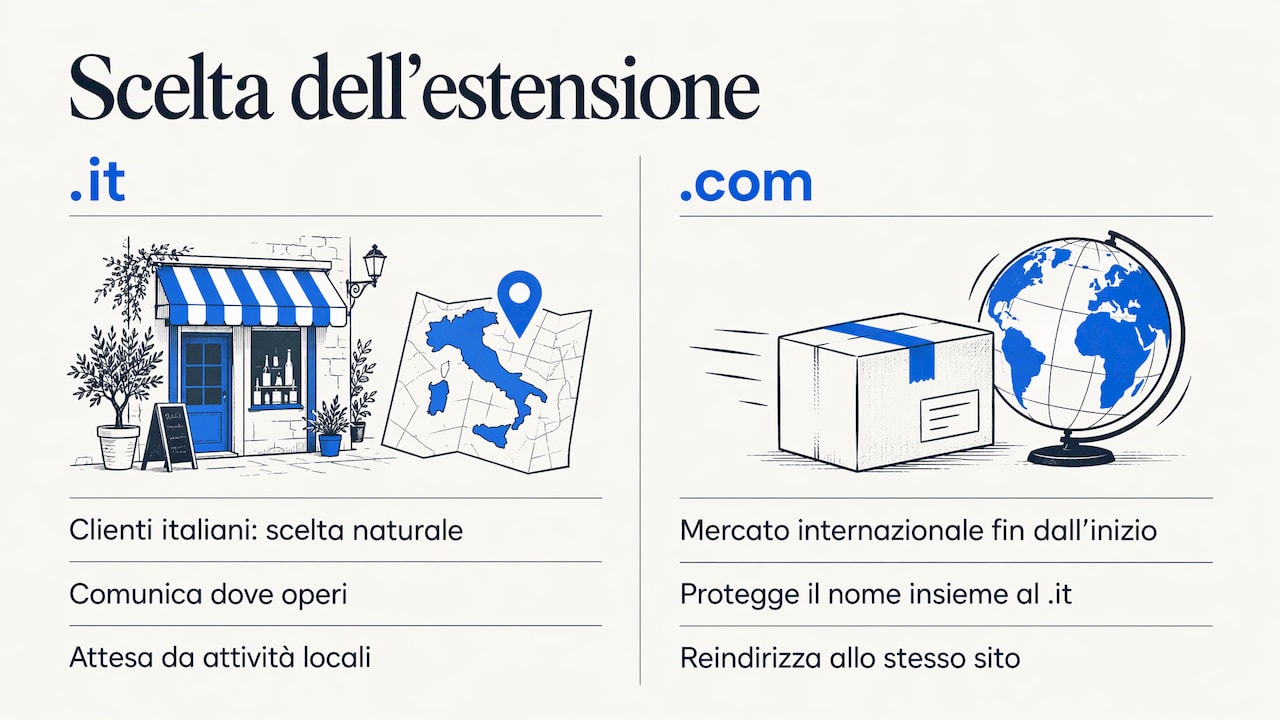
The extension is the final part of the domain, after the dot. For a business serving Italian customers, .it is the natural choice: it immediately communicates where you operate and is the extension people expect from a local business. It is no surprise that it is widely used: according to Registro .it, at the end of April 2026 there were 3,578,851 registered .it domains, up 1.17% from the end of 2025. Among registrants in the second four-month period of 2025, 30% were businesses and 10% were independent professionals.
A .com makes sense when your market is international from the outset, such as an online shop shipping throughout Europe or a startup targeting overseas customers. Many businesses register both: .it as their main address and .com to protect the name and redirect it to the same website.
More unusual or very cheap extensions call for caution. Google’s team has explained that low-cost extensions attract spam, and when an extension is flooded with it, search engines may struggle to handle even legitimate websites using it correctly. For a business built to last, a trusted extension is worth a few extra euros.
The .it rules in brief
Before registering a .it domain, it is worth knowing a few rules set by the Registry. You do not need to be an expert to understand them:
- Who can register one: anyone of legal age with citizenship, residence, or a registered office in the European Economic Area, Vatican City, San Marino, Switzerland, or the United Kingdom. There is no limit to the number of domains you can register.
- Length and characters: the .it assignment regulations set a minimum of 3 characters and a maximum of 63; letters, digits, and hyphens are allowed, but a hyphen cannot appear at the beginning or end of the name.
- First come, first served: domains are assigned on a first-come, first-served basis, and a name cannot be reserved. If you find the right name and it is available, do not wait.
- Reserved names: the names of Italian regions, provinces, and municipalities (such as toscana.it or pisa.it) are not freely available for registration. A geographical name that does not correspond to an administrative body, such as prosciutto.parma.it, can be registered.
- Responsibility: under the regulations, the person registering the domain—the registrant—is responsible for the registration and the information they provide. The Registry also rejects the systematic hoarding of other people’s names.
Accented letters are technically allowed in .it domains, but the Registry itself recommends avoiding them: for a business, caffeitalia.it works better than an accented version that half your customers will type without accents.
How to check that a name is genuinely available
An available domain is not automatically a safe domain. There are three checks to run, in this order.
1. Technical availability
The Registry provides the Find your .it tool to check whether a name has already been assigned. Your chosen provider will also check when you purchase it: with ViceSite, you check the name and, if it is available, register it in the same process.
2. Who already uses similar names
Search for the name online and on social media. If a business with an almost identical name exists in your sector, customers will confuse you and sometimes end up with them instead. Check variations too: singular and plural, with and without a hyphen, .it and .com.
3. Registered trademarks
This is the most overlooked check and the one that matters most. Domain disputes almost always concern names and trademarks: according to Registro .it, 89% of oppositions—disputes initiated by people who believe they have rights to a name registered by someone else—concern distinctive signs such as trademarks and business names. If your chosen name matches a registered trademark in your sector, you risk having to give up the domain after building your website, email, and printed materials around it. If you are unsure about a potential conflict, consult an industrial property adviser or a lawyer specialising in trademarks before registering.
How to register a .it domain
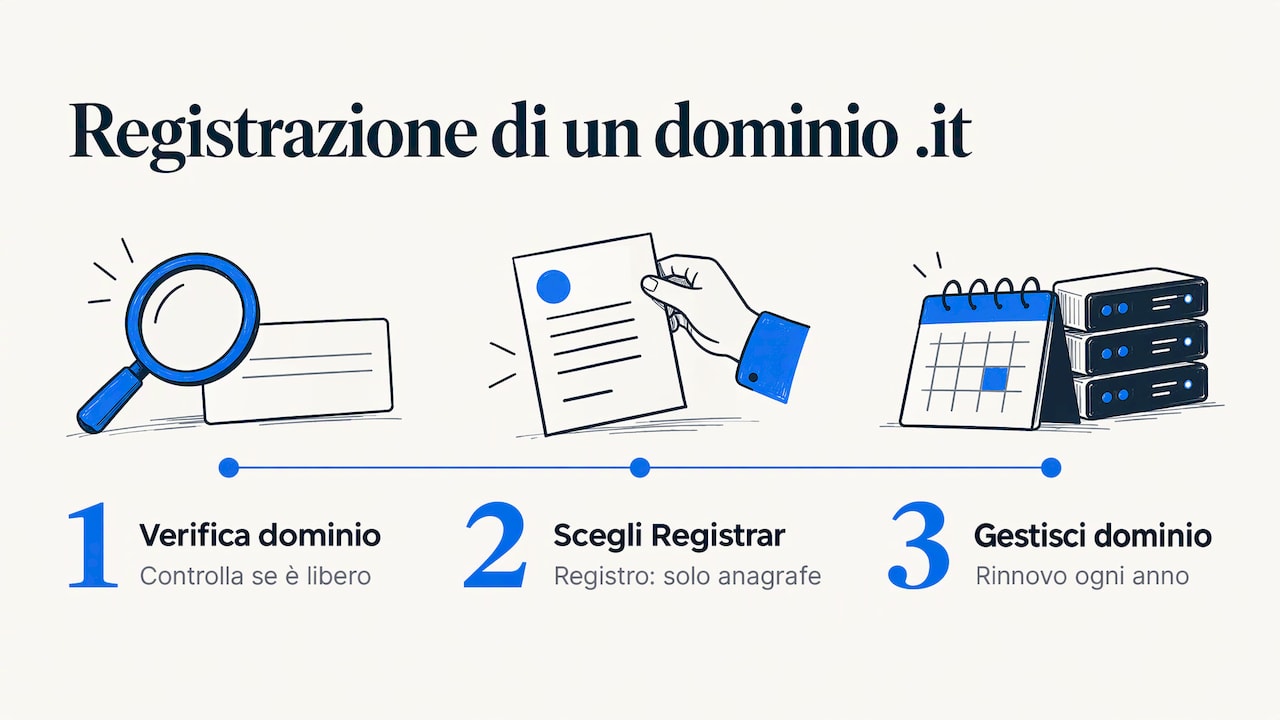
Registro .it describes three steps: check availability, choose a Registrar, and then manage the domain over time. The Registry only maintains the register and does not register domains directly: to get a .it, you go through a Registrar or a provider that handles registration for you.
This is where your choice of provider makes a difference, for three reasons.
Who the domain is registered to. The domain must be registered to your business or to you, not to the provider or the agency that built your website. This is the first thing to clarify, along with what access you will have.
The freedom to switch. A domain tied to a provider keeps you tied to them even when you want to change hosting or websites. With us, there is no domain lock-in: the name remains your business’s.
Clear costs over time. A domain is renewed every year. A low introductory price with a different renewal fee or extra charges discovered later complicates a small business’s budgeting. Our published prices include VAT, with no hidden costs.
Once registered, your domain becomes the foundation for everything else: email accounts using your domain, which instantly create a professional impression, and the space where you publish your website, for which you need suitable hosting. Our guide to choosing hosting for a business website can help with that.
The most costly mistakes
Drawing together the Registry’s guidelines and what happens in practice, these are the mistakes to avoid:
- Choosing a generic name: pizzeria.it is virtually impossible to get and, even if it were available, it would not set you apart.
- Adding hyphens and numbers to work around a taken name: rossi-idraulica2.it is a fallback that customers will mistype.
- Chasing a keyword at the expense of your name: it offers no ranking benefits and ties you to a service or city.
- Using the plural when the singular is taken: people searching for you will type the singular and find your competitor.
- Letting someone else register the domain in their name: if you are not the registrant, the name is not truly yours.
- Forgetting to renew: an expired domain can become available again and end up in someone else’s hands.
- Skipping the trademark check: this is the mistake that can force you to start from scratch.
Your domain with ViceSite
Once you have found the right name, registering it with us is a three-step process: choose your service, pay securely, and enjoy immediate activation. Clear prices including VAT, no domain lock-in, and an Italian team that answers without technical jargon if you have a question about the name or extension.
If you need everything else too, we offer secure hosting, email accounts with your domain, and custom websites, giving you one point of contact for your entire online presence. Choose your domain on ViceSite or, if you already have the name and just need space for your website, request your hosting.
Our perspective
People starting a business often treat the domain as a formality to get through in five minutes, perhaps choosing the first available name that comes to mind. We see it as the first real branding decision: it is the name your customers will write, say, and remember.
That is why we believe choosing a name and registering it go hand in hand. You can have the perfect name, but if it stays tied to your provider or the renewal price comes as a surprise, it is not truly yours. With us, there is no domain lock-in, prices are clear and include VAT, and when you have a question, you speak to real people, in Italian, with no call centres and no tickets that get lost.
Our advice is simple: choose a name that will still represent you in ten years, check that it is genuinely available, and register it as soon as you are sure. We’ll handle the rest—hosting, email, and your website—without technical complications.
Sofia
Frequently asked questions
Is a business name or a keyword better for a domain?
Your business name is better. Google’s team has clarified that keywords in a domain do not provide a tangible ranking advantage, while a distinctive name is easier to remember and protect, and does not limit you as your business grows. If the name alone is ambiguous, add a word indicating your sector.
Should I register both .it and .com?
If you mainly work in Italy, .it is the natural main address. Registering the .com as well is a good way to protect your name, especially if you plan to sell abroad: you can point it to the same website. In any case, avoid very cheap extensions, which Google says attract spam.
Can I change my domain name later?
A registered domain cannot be renamed: to change the name, you register a new one and move your website and email. It is possible, but it involves work and some loss of visibility, which is why it pays to choose carefully from the start. If you already have a website, our team will help you through the transition.
Who can register a .it domain?
Anyone of legal age with citizenship, residence, or a registered office in the European Economic Area, Switzerland, the United Kingdom, San Marino, or Vatican City. Businesses, professionals, and individuals can register as many domains as they want. The name must have at least 3 characters.
What if the name I want is already taken?
A .it domain is assigned to whoever registers it first and cannot be reserved. Try combinations of two words, such as a surname plus the type of business, or the type of business plus the city, or check another trusted extension. Avoid hyphens and numbers used solely to work around a taken name, and do not choose a name that matches someone else’s trademark.
Sources
- Registro .it: Choose a name
- Registro .it: How to register
- Registro .it: Regulations for the assignment and management of domain names in the .it ccTLD, v8.0
- Registro .it: DOT no. 1, 2026
- Registro .it: data for the second four-month period of 2025
- Search Engine Journal: Google, don’t choose cheap TLDs
Recommended reading
Ready to take your business online?
Search your domain: in two minutes you'll know if it's free and what it costs, VAT included.
Find your domain