
Online marketing · Published on October 27, 2026
Online Branding for Small Businesses: A Practical Guide
ViceSite · Vicedomini Softworks srl
How to build a consistent digital identity for your business: definitions, practical steps, a channel checklist, and mistakes for SMEs and professionals to avoid.

Online branding means deciding what you want people to think about your business when they come across it online, then making it happen through every detail: your domain name, your website, the email address you reply from, your social media posts, and how you handle a negative review. You don't need a multinational's budget. You need a clear sense of who you are, consistency across every channel, and a few well-chosen basic tools. This guide covers the definitions that matter, a seven-step process designed for small businesses, professionals, and startups, a consistency checklist, and the mistakes we see most often.
At a glance
- Online branding is the active process of building your business's image and values online: everything you publish helps shape them in your audience's mind.
- Branding, digital marketing, and visual identity are not the same thing: the first defines who you are, the second helps you sell, and the third makes you recognizable.
- Foundations come before channels: your value proposition, audience, values, and tone of voice.
- The technical foundation of a credible digital identity is a domain bearing your name, a professional email address, and a website you control.
- You don't shape your reputation alone: reviews, comments, and replies carry as much weight as the content you publish.
Contents
- What online branding means
- Branding, digital marketing, and visual identity
- The foundations to define before launching any channel
- How to build your online brand in seven steps
- The cross-channel consistency checklist
- Three examples of business digital identities
- Mistakes that weaken an online brand
- Our perspective
- The foundation of your digital identity with ViceSite
- Frequently asked questions
- Sources
What online branding means
The most useful definition for a small business comes from the Unioncamere guide to digital reputation and corporate branding: branding means actively building and strengthening a company's image and values, knowing that what the business communicates online helps shape its image in the public's mind.
The key word is “actively.” You have an online image whether you manage it or not: it's made up of the listing someone finds on a map, the website stuck in 2019, the social media page whose last post was three years ago, and the reviews customers have left. Branding means no longer letting that image take shape on its own and starting to design it.
The same guide distinguishes a second concept, digital reputation: the shared perception of a company's identity among customers and stakeholders, shaped not only by the company's content but also by reviews and online interactions. In practice:
- your identity is what you decide (who you are, what you promise, how you speak);
- your reputation is what other people conclude from what you do and what others say about you.
Online branding works on the gap between the two. The smaller that gap, the more credible your brand.
Branding, digital marketing, and visual identity
These three terms often overlap in conversations with agencies and consultants, and confusing them leads to wasted spending. A clear distinction is offered in this overview of digital branding: digital branding defines your online identity, image, and reputation; digital marketing promotes products or services and encourages specific actions; visual identity includes elements such as your logo, colors, and fonts.
| Online branding | Digital marketing | Visual identity | |
|---|---|---|---|
| The question it answers | Who are we, and why choose us? | How do we bring in customers now? | How do people recognize us at a glance? |
| Time frame | Long term | Campaigns, short- and medium-term goals | Stable, rarely changes |
| Practical examples | Value proposition, tone of voice, company story, review management | Social media advertising, promotional newsletters, seasonal offers | Logo, color palette, typefaces, photography style |
| How it's measured | Trust, word of mouth, searches for your name, review quality | Inquiries, quote requests, sales | Recognizability and consistency across materials |
The relationship between the three is hierarchical. Branding comes first: without knowing who you are, an advertising campaign brings visits that don't turn into customers, and a beautiful logo remains a meaningless drawing. Visual identity is the graphic expression of branding; marketing is the megaphone that amplifies it.
This also answers a common question: what is the difference between branding and visual identity? Visual identity is one part of branding—the part you can see. Branding also includes what you hear (the tone), what you experience (the service), and what you tell people (the story).
The foundations to define before launching any channel
The Unioncamere guide sums up the starting point in one sentence: decide what you want your audience to think about your company and how to communicate it, then support that image with concrete actions, consistent experiences, and a clear message. Positioning is the space your brand occupies in people's minds; communication is the means of getting there.
Translated into a pen-and-paper exercise, before you touch your website or social media, you need four answers.
1. Your value proposition
In one sentence: what you do, who you do it for, and why they should choose you. “Physiotherapy practice” isn't enough. “Sports physiotherapy for recreational runners, with appointments available on Saturday mornings too” is. A specific proposition excludes some people, and that's exactly what makes it memorable for those who remain.
2. The audience you want to reach
Describe two or three typical customers using real details: what they do for work, how they look for you, and what worries them before they get in touch. A tradesperson who works with apartment buildings and one who works with individual homeowners need different websites, tones, and content.
3. The values you can demonstrate
Everyone writes “quality, professionalism, passion.” Choose values you can back up with facts: punctuality (so you publish delivery times), transparency (so you list prices, or at least price ranges), craftsmanship (so you show your workshop). A value without evidence is a slogan.
4. Your tone of voice
Do you address people casually or formally? Do you use technical terms or explain them? Are you playful or businesslike? Write down three simple rules and keep them within reach of anyone who publishes on your behalf. Tone is the element that most often falls apart between channels, because the owner writes the website, a nephew handles social media, and a salesperson writes the emails.
How to build your online brand in seven steps
Once the foundations are clear, it's time to put them into practice. Here's the order we recommend for a small business starting from scratch, or close to it.
- Register a domain with your name. It's your address on the web and, unlike a social media page, it's yours. Keep it short, easy to dictate over the phone, and free of unnecessary hyphens. For a business operating in Italy, the .it extension immediately tells people where you work; if you also serve international customers, consider adding another extension alongside it.
- Set up an email address on your domain. A quote sent from nome@tuaimpresa.it carries more weight than one from a generic address on a free email service. It's one of the most affordable and most overlooked branding steps.
- Build a website that reflects your identity. Your website is the only online space where you decide everything: structure, messages, images, and the visitor's journey. Within a few seconds, it should tell people who you are, what you do, and how to contact you, using the same logo, colors, and tone you'll use everywhere else.
- Choose a few social channels and manage them well. Two well-maintained profiles are better than five abandoned ones. Choose the places where your audience actually spends time: a restaurant and a tax advisory practice don't need the same channels.
- Look after the listings that represent you. Maps, industry directories, booking platforms: check that your name, address, opening hours, phone number, and website are identical everywhere. Incorrect opening hours on a listing mean a disappointed customer before they even walk in.
- Publish useful, professional content. The Unioncamere guide specifically lists this among its recommended business practices: valuable content that's consistent with the brand. For a small business, that might mean answering the questions customers always ask, showing a completed project, or explaining how the service works.
- Reply to comments and reviews. Reputation also takes shape through interactions: replying in your brand's tone is as much a part of branding as your logo. According to the same guide, a strong online reputation can improve the conversion of visitors into customers and help attract skilled people who want to work with you.
The cross-channel consistency checklist
According to the Unioncamere guide, the elements to keep consistent are your logo, mission, tone of voice, and storytelling across every channel: website, social media, newsletters, and promotional materials. Use this table for a regular check every few months.
| Element | Website | Social media | Email and newsletters | Listings and directories |
|---|---|---|---|---|
| Business name | Identical to the brand name | Same name in the profile | Same sender name | Same name, without variations |
| Logo | Main version | Version suited to a square format | Legible in the signature | Same version as the website |
| Colors and fonts | Defined palette | Same palette in graphics | Same colors in templates | Photos consistent with the style |
| Tone of voice | The three written rules | The same rules, perhaps more informal | The same rules | In replies to reviews |
| Contact details | Complete and up to date | Link to the website | Email on your domain | Identical phone number, address, and opening hours |
| Value proposition | On the first screen | In the bio | In the signature or footer | In the description |
If something in a cell doesn't match, you've found a point where your brand loses strength.
Three examples of business digital identities
To make the method more concrete, here are three typical scenarios created for illustration.
A neighborhood pastry shop. Value proposition: traditional pastries made fresh every morning, available to order for celebrations. A domain with the shop's name, a small website with real photos of the counter, special-occasion menus, and an order form. On social media, photos of the kitchen at dawn use the same warm filter as the website. The owner replies to reviews and signs off with their name.
A self-employed employment consultant. Value proposition: payroll management for small businesses, explained without bureaucratic jargon. A clean, understated website with a section answering customers' most common questions, an email address on her own domain, and a single professional social profile where she posts plain-language explanations of industry updates. Her clear, reassuring tone is the same across every channel.
A startup selling an app for gyms. Value proposition: class bookings without phone calls. A short name and a domain registered before launch, to avoid finding it already taken. A distinctive visual identity with a dominant color that's recognizable even in the app icon. Stories about the founders and team culture to attract the first developers—a practice the Unioncamere guide explicitly mentions.
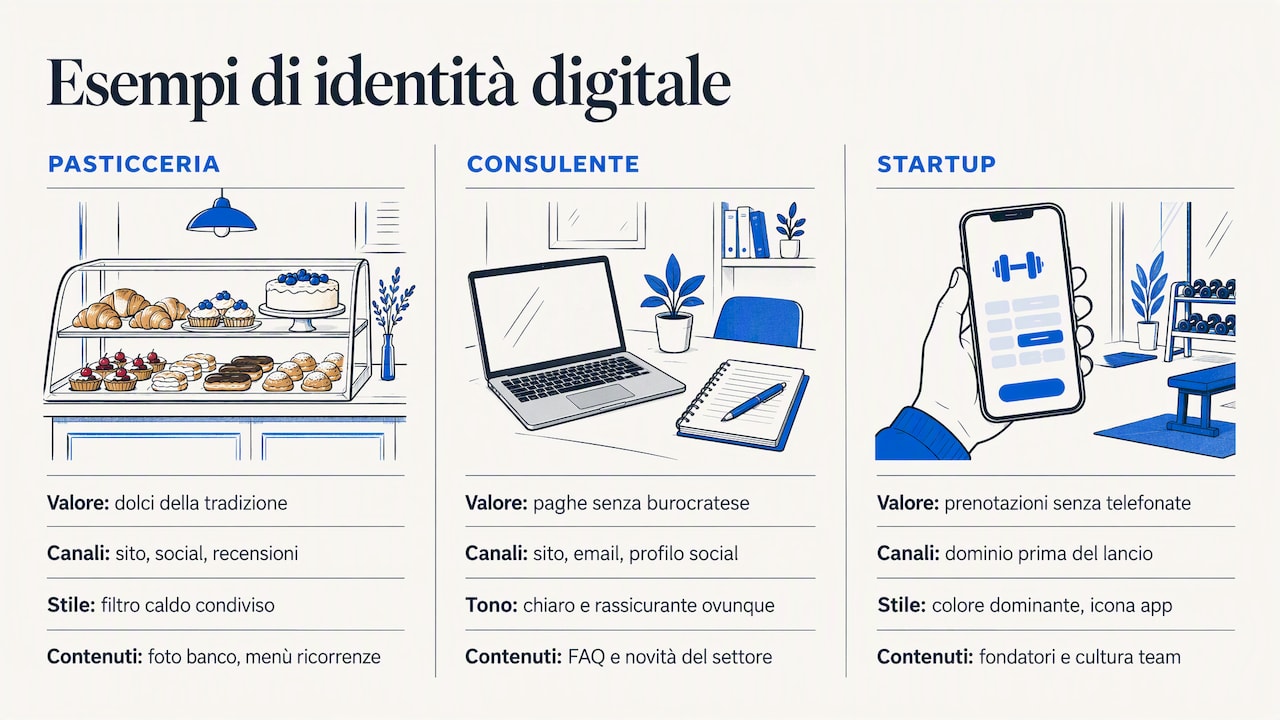
In all three cases, the budget is modest. What makes the difference is that every element tells the same story.
Mistakes that weaken an online brand
- Building everything on platforms you don't control. A social media page can face changes to its rules or visibility, or even disappear. Your domain and website are your own land; social media profiles are rented storefronts.
- Registering the domain in someone else's name. Domains are often registered in the name of a former provider or a colleague. When you change providers, you risk losing your address. Always check who owns it and choose services that don't lock you in.
- Changing your logo and colors every season. Recognition comes from repetition. If you want a refresh, do it once and update every channel together.
- Making promises online that your service doesn't keep. The Unioncamere guide is clear: your image must be supported by concrete actions and consistent experiences. If your website says “same-day response” and you reply a week later, the negative review practically writes itself.
- Ignoring reviews or replying impulsively. Criticism handled calmly and in your brand's tone often convinces people more than ten compliments.
- Relying on providers who speak only in technical terms. If you don't understand what you're buying, you can't decide whether you need it. A good partner explains the choices in plain language.
Our perspective
We work with Italian small businesses, professionals, and startups every day, and this is what we notice most often: online branding almost always gets stuck on the technical side, not the creative side. Owners know perfectly well who they are and what they offer. What holds them back is a domain registered to someone else, hosting credentials they can't remember, fear of touching the website because “it'll break,” and bills full of incomprehensible items.
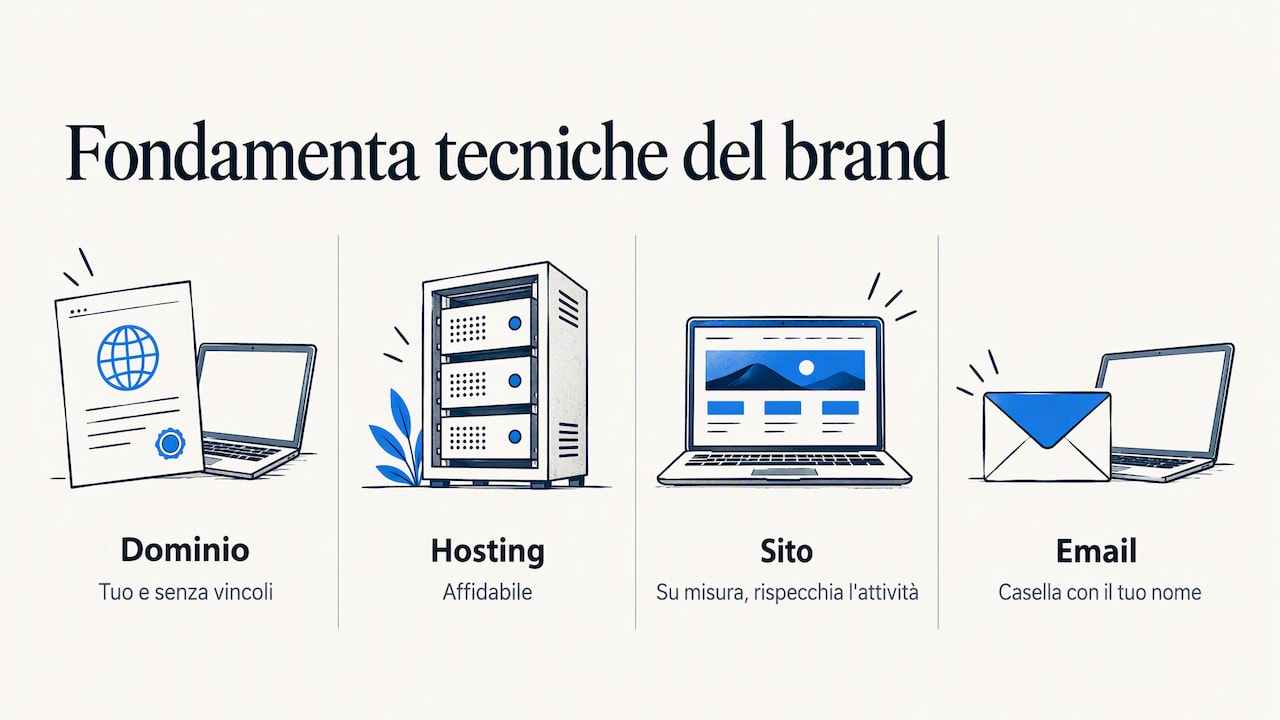
That's why we believe the first branding step is to get the foundations in order: a domain you own with no lock-in, reliable hosting, a custom website that truly reflects your business, and an email address with your name. When the foundation is solid and easy to understand, everything else—content, social media, reviews—becomes easier to manage consistently.
We also believe that the way a company provides support is part of its brand. If you reply to a customer clearly and without beating around the bush, your brand grows stronger. The same applies to us: that's why we speak Italian, avoid jargon, and prefer direct contact to tickets that get passed around.
— Sofia
The foundation of your digital identity with ViceSite
If you want to start with the foundations, ViceSite brings together everything a small business needs to establish an online presence under its own name: domain registration, secure hosting, custom website creation, and email account management. Prices are clear and include VAT, with no hidden costs and no lock-in on your domain, which remains yours.
The process has three steps: choose your service, pay securely, and your service is activated straight away. If you're unsure which domain to choose or how to set up your website to reflect your business, real people from our Italian team are there to answer. Explore domains, hosting, and custom websites.
Frequently asked questions
Where do you start when building your own brand?
With the foundations, not the logo: your value proposition, audience, demonstrable values, and tone of voice. Only then do you move on to visual identity and channels. In practical terms, your first step online is to register a domain with your business name before someone else does.
How long does it take to see results from online branding?
Branding works over the long term: trust builds through repeated, consistent messages and experiences. Some effects are immediate, such as the extra credibility of an email address on your own domain or a well-maintained website. Others, such as word of mouth and positive reviews, grow month by month if you stay consistent.
Does a small business really need a website if it's already on social media?
Yes, because your website is the only online space you control completely, while on social media the platform decides the rules and visibility. Your website is also the central reference point that keeps all your other channels consistent. Social media works better when it links to a website that backs up its promises.
Are online branding and personal branding the same thing?
The method is the same; the subject changes: in personal branding, you are the brand as a professional, with your name, expertise, and voice. For a self-employed professional, the two often overlap, and it's useful to have a personal domain and website that bring together your work, services, and contact details.
How often should you check brand consistency across channels?
Every few months is a good rhythm, and always whenever something changes: opening hours, address, services, or logo. Use a checklist covering your name, logo, colors, tone, contact details, and value proposition, and check that they match across your website, social media, emails, and listings.
Sources
Ready to take your business online?
Search your domain: in two minutes you'll know if it's free and what it costs, VAT included.
Find your domain